
Free art lesson. Print and play with this how to draw step by step guide. If you can draw a circle, triangle, oval, and a line you can draw Buddy! Don’t forget to color him in.


Be Someone's Rainbow
You can be a rainbow
on a cloudy day.
You can be the sunshine
the wind can't blow away.
You can tickle someone pink,
when they’re feel’n blue.
You can share the hope,
that lives inside of you.
You can wipe away the mean,
the ugly and the hate.
You can share your kindness
before it is too late.
You can shine so bright,
even in the dark.
You can bring the light.
You can leave your mark!

Biology Basics: How Animals Reproduce
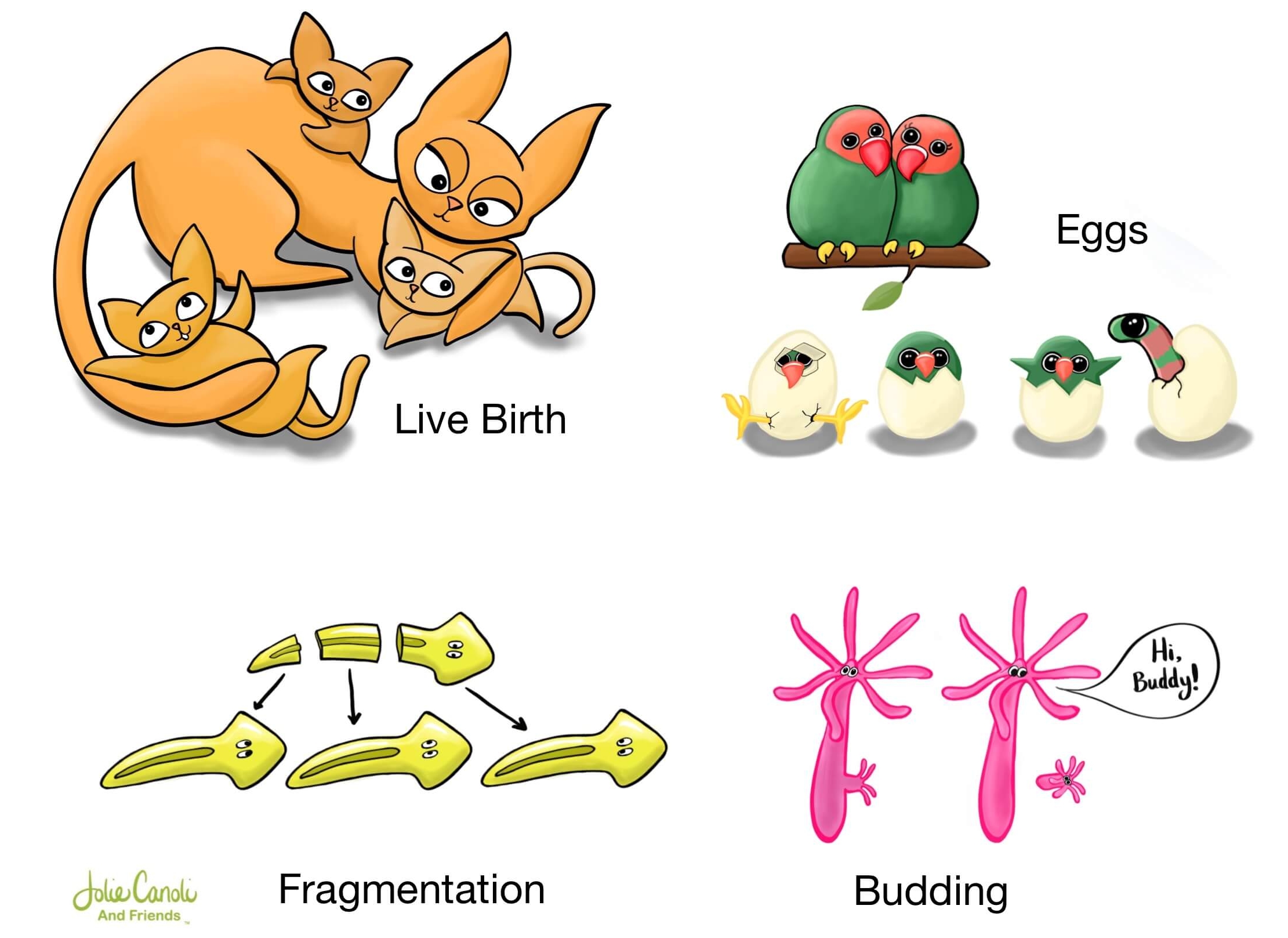
Two types of two-parent reproduction (sexual) and two types of one parent reproduction (aseuxual) are seen in animals. It seems crazy to think that animals can reproduce with only one parent, but with more simple creatures like worms and jellyfish, it happens!
Download the PDF for more a simple memory poster, fun facts and a quiz!
Two-parents Reproduction
Two parent reproduction ensures genetic variation in each new offspring. This makes for unique traits of each young, and allows for greater protection from disease. However the animals must find a mate in order to have new babies. The two types of two-parent reproduction are live birth and eggs.
Birds are the first thing I think of when I think of animals laying eggs. But many other animals lay eggs, too. Reptiles, Amphibians, Fish, and many invertebrates lay eggs. In fact, only Mammals give live birth!
One-Parent Reproduction
Most animals that reproduce asexually are simple creatures like invertebrates, like worms, jellyfish, and sea stars. Fragmentation and Budding can also be called cloning, because the offspring are identical to the parents. The advantage to asexual reproduction is that these animals can reproduce even if they cannot find a mate. However the offspring that are created have identical genetic information as the parent, and therefore one disease can kill off an entire population of cloned animals. They can also reproduce much quicker, but that means they can easily overpopulate and compete for resources.
These fascinating methods of reproduction make for some fascinating animal baby stories. Enjoy the PDF for more info!

LIfe Sciene Workbook
Enjoy illustrated lessons and playful quizzes on Animal Cells, Plant Cells, Classification of Living Things, Invertebrates & Vertebrates, Plant Identification, and more!
Vertebrates- Animals with Backbones

See these animals giving one another a back rub? They are all vertebrates. Vertebrates are animals with backbones (vertebrae). The 5 classes of vertebrates are: Fish, Amphibians, Reptiles, Mammals, and Birds.
Fish (Gills, Fins, Scales, Cold Blooded)
Fish are the only group of vertebrates that live entirely in water. All of them have gills, which is special breathing tissue that allows fish to breathe oxygen underwater. Fish have fins which help them paddle and maneuver through water. They also have scales that protect their bodies like armor. You can actually determine the age of fish by counting the rings on their scales! Fish are cold blooded animals which means their blood becomes cooler or hotter depending on the temperature of the water. Fish will swim slowly below the ice during winter, or even sleep in icy waters. Some fish actually produce antifreeze molecules called glycoprotein that keep their bodies from freezing in really cold temperatures!
Amphibians (Slimy skin, Metamorphosis, Four Legs, Cold Blooded)
Amphibians like frogs, toads, and salamanders are born in water and develop the ability to live on land. This means almost all amphibians will go through metamorphosis. (Think of how tadpoles become frogs.) Most are born with gills and then develop lungs and four legs, though caecilians do not have legs. They have permeable, wet, slimy skin that absorbs water and oxygen, and usually have webbed feet. Amphibian eggs have no shell, but are covered in a jelly-like substance. Amphibians are also cold blooded, so they are quick and active when it is warm, but slow and sluggish when it is cold.
Reptiles (Scales, Eggs, Four Legs, Cold blooded)
Reptiles like turtles, snakes, crocodilians, and lizards are covered with scales, and usually have claws. Reptiles are cold blooded creatures and lay eggs. They are tetrapods, meaning they have four legs, or in the case of snakes, “descended” from creatures with four legs. Interestingly there are a number of snake fossils with legs, and some pythons have vestiges of legs.
Mammals (Hair, Milk, Live Birth, Warm blooded)
Mammals can be bears, bunnies, or even whales. Mammals give birth to live young. Mammals get their names from mammary glands that produce milk to feed their newborn babies. All mammals have hair or fur that helps them maintain their warm blooded bodies. All mammals have lungs and breathe air, so most mammals live on land, but some live in the sea. These marine animals include pinnipeds (seals, sea lions), cetaceans (whales, porpoises), sea otters, sirenians (manatees), and polar bears.
Birds (Feathers, Beak, Eggs)
Birds can be as tiny as a hummingbird or as large as an ostrich. All birds have feathers, though not all of them fly. Penguins have feathers, but they swim. Ostriches and emus have large feathers, but their sternum is not attached to their pectoral muscles, making them too weak to fly. All birds have a beak. Beaks come in many shapes and sizes, and are used for different purposes, including tearing meat, breaking seeds, sipping nectar, fishing, or finding and eating insects.
Enjoy the FREE printable vertebrate packet more fun illustrations, a poster, study guide, and short quiz!
For more fun consider studying:
Different types of feathers
Four types of fish scales (Placoid, Cosmoid, Ganoid, Cycloid)
Explore reptiles!
Go find some frogs at your local pond! Be sure to wash your hands…
Try making a list of the mammals that live in your neighborhood. Or try one of these cool ideas!
Visit the local pet shop and see if you can identify what creatures belong in which vertebrate class!
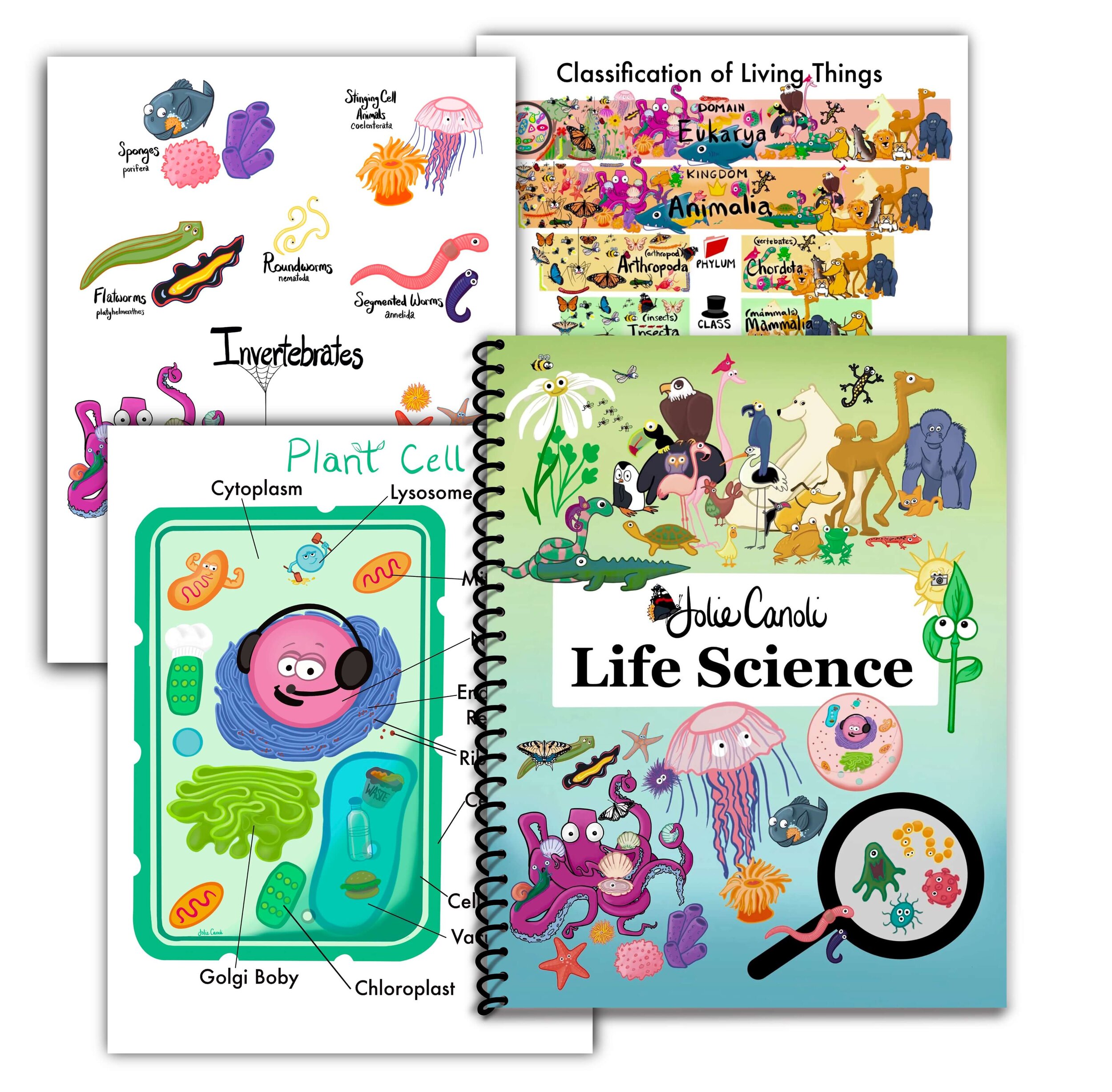
Life Science Set
Check out the new book and posters!
Biology Basics: Invertebrates
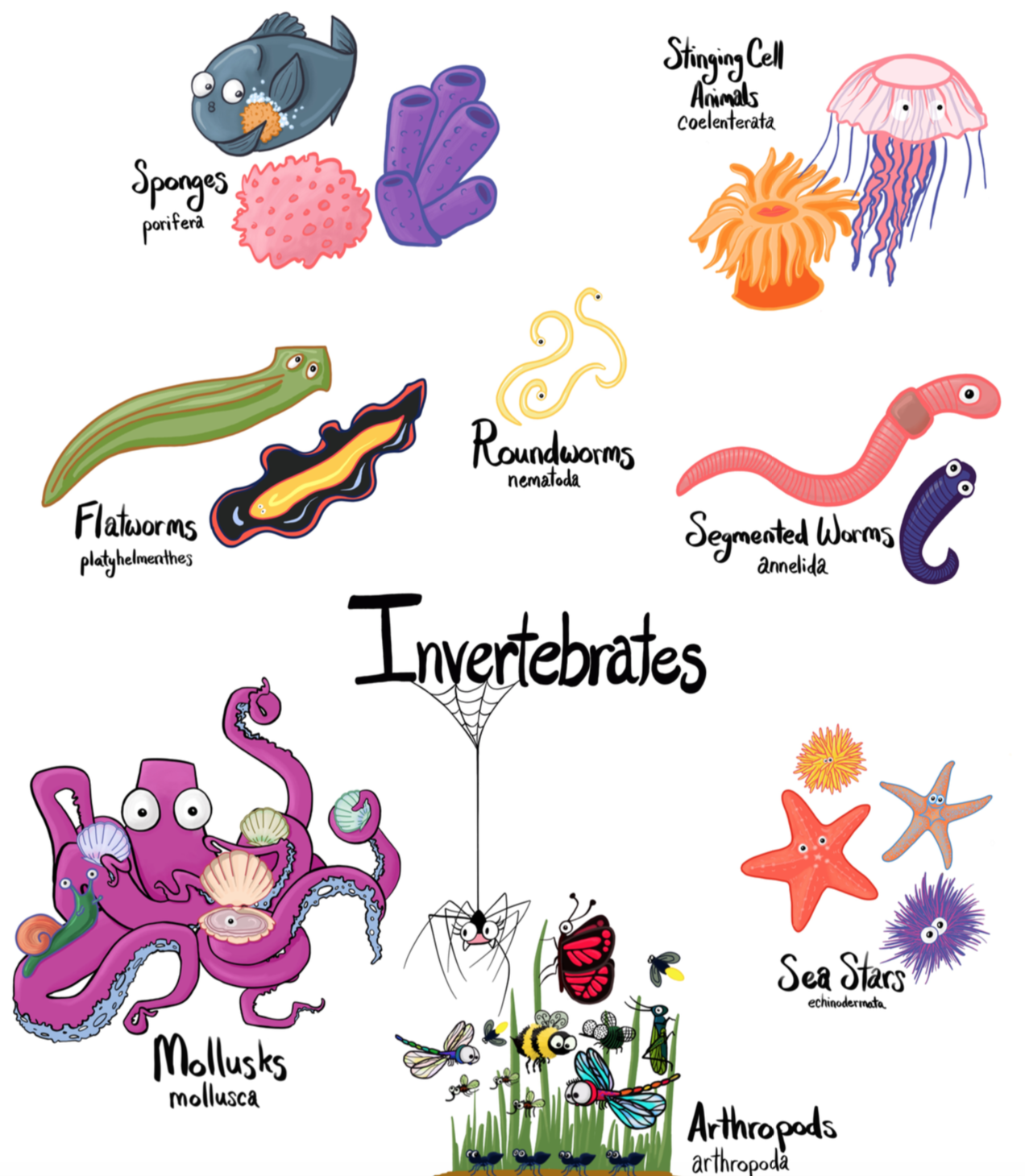
Invertebrates are definitely some of the weirdest, creepiest, slimiest and most interesting creatures on earth. Worms, bugs, octopus and jellyfish all fall into the category of inveterate animals. When looking at the classification of the animal kingdom, there are 9 major phylum, and 8 of these are invertebrates! These 8 phylum, or body-type classifications are sponges, stinging cell animals, three groups of worms (flat, round, segmented), mollusks, echinoderms (also known as sea stars), and arthropods.
One of the best parts about studying invertebrates is the ease of finding them in your own backyard. Many of the invertebrates are easy to find if you just dig in your garden, or even, heaven forbid, look in your basement! If your kids have the courage, they can handle the creepy creatures and study them first hand- literally!
I’ve attached a handy dandy printable with a poster, study guide, and a quiz. Hope you enjoy this invertebrate study tool!

Check out the full Life Science Workbook!
Jolie Canoli Life Science workbook is packed with playful illustrations, easy to understand science lessons, playful quizzes, and educational activities. Perfect for elementary students studying Classification of Living Things, Biology and Botany.