I don’t want my kids to just learn to read; I want them to thrive! I want them to actually understand what they read. I want them to write intelligently, grapple with new words they encounter, and ultimately, enjoy reading!
This command of language begins with learning to read the right way.
The reality is that you can teach children to read without giving them the tools to read independently and confidently. The difference between basic reading skills and long-term excellence in reading is determined by building a strong foundation in the English Language — and that requires phonics.
Children who learn to read with phonics thrive in reading, spelling, and writing.
Students with phonics instruction score substantially better than their peers.
Why would that be? Why is phonics so important?
Many people look at the English language, pointing out the strange anomalies or rule-breakers and say, “This language makes no sense— why even bother?!?”
The reality is that English is a phonetic language. While there are occasional abnormalities or odd words, this does not unravel the basic foundation of reading, which is phonetic pronunciation, every time.
The Downfalls of Sight Reading
Teaching children to read with whole language methods is a trend that has led to students who cannot decipher new words. Whole language methods, in contrast to phonics methods, teach children whole words by using context, picture references, and sight-word drilling. Whole language methods can assist readers when used with phonics, but without phonics they become hollow and incapable of producing fluent readers.
Whole language methods produce children who flounder in spelling, writing, and independent reading. Methods like sight reading are, simply put, not enough to fully teach English.
The tendency to prefer whole language methods often occurs when readers struggle with monotonous black-and-white text. Letters seemingly blur into nonsensical shapes. Children beginning to read are just starting to grasp the idea of abstract thinking. This abstract thinking says, “This shape (letter) signifies a sound,” or “This shape (number) signifies an amount.” When they have to decipher 26 letters and their many sounds, plus digraphs like ʻphʻ shʻ and ʻigh,ʻ students who are not developed in abstract thinking struggle.
Encouraging other forms of language development —reading aloud to children, storytelling, and word games— help children who lag in forming abstract thinking. Hearing words and proper command of language develops depth of language. Often overcoming the hurdle of grasping abstract thinking is just a matter of time; some kids need more time to be ready to read, and once they are ready, catch-up easily with their peers.
Certain children have specific reading hurdles to overcome— such as dyslexia or dysgraphia. While these may require extra professional assistance, often these hurdles are overcome with phonics.
Phonics Enable Independent Reading
Teaching children to read phonetically enables them to decipher new words. Phonics teaches the English language the way it was intended to be understood and read, from an alphabetical structure. All romance languages function this way (French, Spanish, Italian, etc.), and without this basic groundwork, students suffer.
When a child encounters a new word using sight-reading or whole language methods, they come to a standstill, unable to read that word; they must seek out someone who has read it before. Context helps with understanding the word, but pronunciation and familiarity are absent when the student lacks phonetic underpinnings to decode the word.
This is where Jolie Canoli Phonics seeks to bridge the gap by building phonetic connections from the beginning. Alphabet books almost never teach all the basic letter sounds. Either G says “g” in gumball or G says “j” in giraffe, but you rarely see both. Jolie Canoli Phonics aims to create books that systematically teach all the letter sounds in an approachable manner.
One of my children was highly visual in his learning preference and struggled with dyslexia. For him, reading did not come easily. Teaching him taught me the importance of visual cues in learning phonics. I taught him that the letter E says “eee,” but he became frustrated when he was told E says “eh” in egg. He was unable to link this new sound to the same letter until I created a new visual, turning an E into an elephant. My book series brings these multiple sounds forward from the beginning, allowing children to connect multiple sounds to one letter and giving them practical tools to make learning to read accessible and fun.
Learning letter sounds with colorful illustrations, rhyme, mnemonics, and sound repetition helps children transition from practical thinking to abstract thinking. Meaningful and recognizable shapes encourage laughter and play in the midst of learning a new set of deciphering skills. Most teaching methods engage seeing, hearing, and doing, but often the seeing is disconnected from the symbols. Seeing a black letter next to an animal doesnʻt easily connect visual to auditory understanding. Jolie Canoli phonics strives to make these connections easier and clearer- the C isnʻt next to the cat; the C is the cat. The shape and sound are embedded in the letter shape, and the sounds are natural outflows of the visual image.
Reading Becomes a Joy— Jolie Canoli Phonics
I believe a love of learning is crucial for developing academic success.
When learning becomes a chore, children develop a disgust for schooling and even learning itself. Thatʻs why I created my phonics series. I want to help kids find joy in learning to read.
Jolie Canoli Phonics series is highly visual, playful, and tackles learning from every angle— sound repetition, visual cues, shape recognition, tactility, and fun!
The book series makes teaching phonics as easy as reading a book. You can get the whole series here or on Amazon. Try our free coloring page downloads below, or purchase the printed full alphabet activity book. Make learning fun and give children the gift of independent lifelong reading fluency with phonics.
Sources:
Developing Early Literacy— Report of the National Literacy Panel: A Scientific Synthesis of Early Literacy Development and Implications for Intervention, National Institute for Literacy, 2008.
Early Reading Instruction: Results of a National Survey. EdWeek Research Center, 2020.
M. Seidenberg. The Science of Reading and Its Educational Implications. Lang Learn Dev. Vol 9, Aug 26, 2013, p. 331. doi: 10.1080/15475441.2013.812017
Jeynes, William H., A Meta-Analysis of the Relationship Between Phonics Instruction and Minority Elementary School Student Academic Achievement. Volume 40, Issue 2. Sage Journals, June 29, 2007.
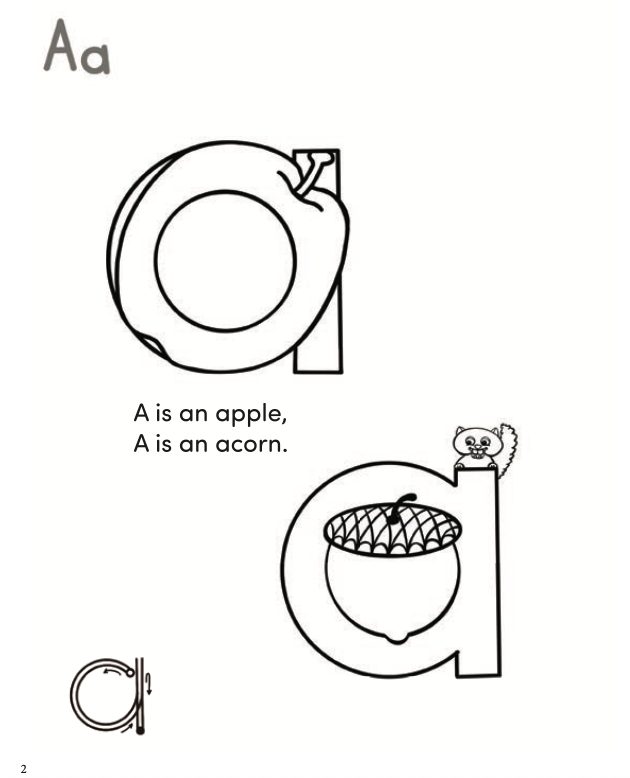
Phonics Coloring Pages
Color each letter that looks like it’s sound! Trace the letter with your finger.