How a Little Engine Could, and You Can Too
Have you found yourself tackling some difficult situations in your life? I assume that since you are a human like me there are some frustrating things in your life that require hard work to overcome. Often the hardest step of overcoming a challenge is the first one–getting the right mindset about your situation. The second hardest part is being consistent! Pushing ahead, day to day, faithfully following through, knowing you will eventually get where you are hoping to be.
Our hero of the day is the Little Engine That Could.
His first step was his mindset.
It was, like the man on the moon, the first step that was a great leap beyond all others. Unlike his predecessors, Little Engine tackled his challenge with hope. The biggest difference between Little Engine and every other train was this mindset.
I think I can.
Next, he had to follow through. Push ahead, keep going, not give up, keep on keeping on! Little Engine maintained his hopeful mindset to push over the high mountain with his heaviest load.
I think I can, I think I can, I think I can.
Faithful follow-through is a rare quality that produces good fruit. God’s faithfulness gives us hope and security in every circumstance. He is reliable, trustworthy, consistent, and always good. His faithfulness ensures that we will see His promises fulfilled at the end of our story.
The Bible says that our faith is a substance; it’s the steam of our engine, the proof in the pudding, the life in our work.
Now faith is the substance of things hoped for, the evidence of things not seen. Hebrews 11:1
That faith in the living God compels us ahead, solidifying us to follow through to completion. Faith is an important part of being faithful. We hold onto truth, setting our eyes on a goal, and press forward because we know that the outcome is worth the effort. We can press on because we believe in what we are called to do, and that even though the road is hard, the outcome is worth our effort.
I think I can, I think I can, I think I can.
As I step into homeschooling another year, I recognize my continual need for steady vision. When teaching 4 kids of different ages, interests, and needs, I can get overwhelmed with the task. It isn’t always easy. But I press ahead because I know that every little step is going to lead me to a full journey. I am not racing them to a finish line; I am guiding them to a full life, guarded by divine purpose and supported in love.
I am building a future.
That kind of work requires the right mindset, and the faithful follow-through. Without the mindset, I will give up before I see the progress. And without the follow-through, it doesn’t matter how great my ideas were, for they never grew feet to make a mark.
“Be faithful in small things, because it is in them that your strength lies.”
-Mother Teresa
Like a little engine, too small for its task, we can complete seemingly impossible tasks because of a God who is able to do beyond all that we ask or think. (Ephesians 3:20-21.)
Set your vision.
Push through.
As you push and huff and puff faithfully, enduring, you will see the other side of that mountain.
I thought I could. I thought I could. I thought I could.
I created a vision casting worksheet to help you get a glimpse of where you are heading and how you want to get there. Check it out below!
What Kids Learn From Reading At Every Age

Now, more than ever, research is being conducted on how much learning kids do during the ages 0-5 years. If you aren’t up on all of it, this documentary discusses it well. Reading and stories are a wonderful way to engage them from the very beginning, with the benefits changing as your child learns and grows.
Jolie has a great article about how important telling stories to your kids are. I was especially focused on her tips for creating stories on the spot since I automatically reach for the bookshelf.
Reading that post got me thinking about how my three children, all under age 5, have interacted with stories and books during this critical time for absorbing information. Reflecting back, it has been fascinating to watch and observe their experience with stories as they have aged, and in hindsight pair it with developmental milestones.

Newborns & Babies
As newborns, they are most focused on your voice, snuggling, and having you close by. They are content to listen to you talk.
Up until 6 months when most become mobile, you have their undivided attention for almost as long as you are willing to read to them - naps and eating aside. I picked any book I wanted and read as much as I wanted from it.
From 6 months to 18 months, they become more focused on motor skills. Interest in books takes on the role of “I can hold and carry this” and “let me turn the pages”. I rarely got past two pages in a book before they were up and finding a new one to carry and turn pages in. Board books and touchy-feely stories are perfect now.
Toddlers
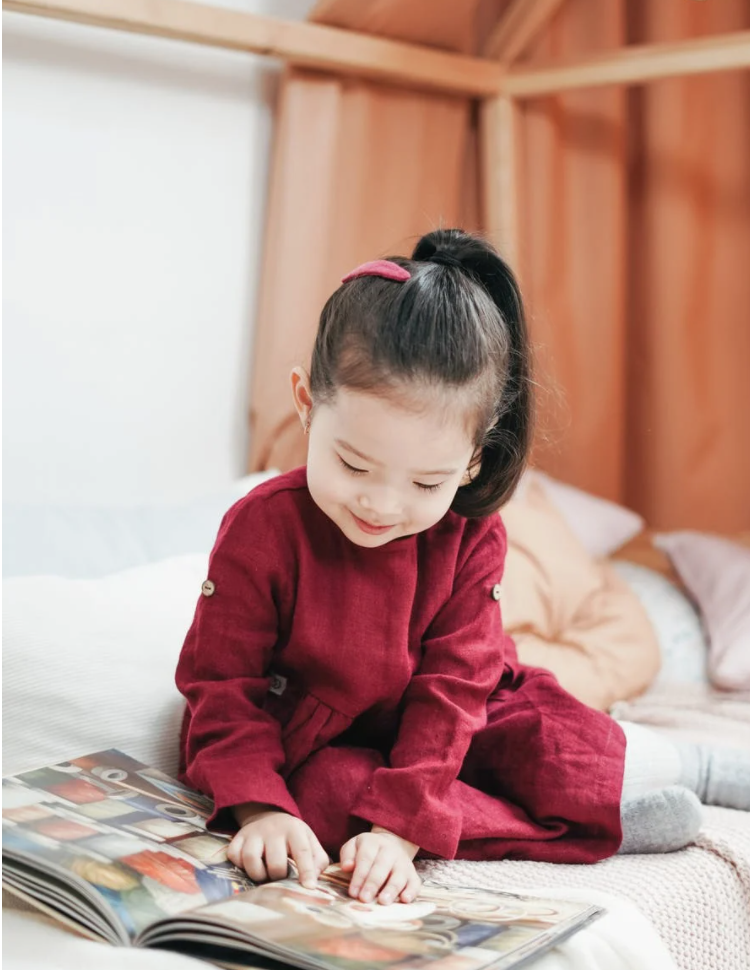
Somewhere in the 18-24month span, my kids were willing to sit and listen again. Books needed to be short, which lots of engaging pictures, but they would listen. I found myself reading full stories out loud again, and often on repeat of 5 times in a row. In the repetition they picked up new things each time. The predictability allowed them to absorb sentence structure, new words, grasp the story’s flow, and participate with “fill in the blank” opportunities if I pretended to forget a word.
From 34-36 months we started to read longer picture books from start to finish. On almost every library visit we return home and start reading. Typically, we end up reading through all the new books that same day.
More recently, companies like Wonderbooks and Vox Books have designed an audio version of the story that is attached directly to the book for readers who want more than mom or dad can handle on a given day. Sold exclusively to libraries, they are a welcome update to the CD/Book idea.

Preschoolers
At four years old, we started reading chapter books with pictures. It give us as parents a little more to invest into, and a new story to follow for several reading sessions. The amount of pictures in early chapter books vary, so be sure to pull it off the shelf and thumb through it first. Classics like “Willy Wonka and the Chocolate Factory” and “Matilda” are great places to start.
I’ll be curious to see what happens when my oldest has learned to read on his own. He already goes to bed with the light on and a book in hand to stare at the pictures once we leave the room.

Independent Readers
I have not hit this stage with my children yet, but as an avid reader myself, I know the multitude of benefits reading has provided me.
Vocabulary is probably the most obvious. I love the meme that says do not make fun of a person who mispronounces a word because that means they probably learned it through reading. This rings true to me more often than I’d like to admit because it means I mispronounce a lot of words.
Another benefit is using your imagination and being able to escape a situation. You can also relate to and learn from characters.
Non fiction books (fiction can too) teach you things without realizing the process is happening. Books are also great resources when you purposely want to learn about something.
Reading also helps you become a better writer as you internalize sentence structures, experience how authors weave a narrative, and understand different ways words work together.
Do You Love Books Too?
I love them so much that when I decided to pass along some tips I used while parenting three under age three for over a year, I chose the format of a book for the content. It makes a perfect gift to buy yourself or someone you love. As this reviewer states “I literally use these tips everyday. This is my new go to baby shower gift because of how helpful it is. Highly recommend!”.
Find my recently released book “15 Ways For New Moms To Manage Stress & Stay Sane: The Actually Useful New Mom Care Package” everywhere books are sold.
I discuss 15 ways not commonly written about you can use daily to make life easier while on yourparenthood journey. Each tip will help you manage your mental stress and organize your day to make you a happier mom.
Written by a mom who had three kids under age three for over a year. Edited and influenced by first time moms who are past the first year. Made for moms who want to:
• Learn about ways to organize their day and manage their expectations.
• Discover how to tap into their local community, family, and friends for support.
• Minimize stress caused by four main money concerns by implementing provided strategies.
• Maximize their mommy/baby bond with four parenting frameworks.
Whether pregnant for the first time or home with your fifth newborn, it helps you get a handle on your stress levels, stay sane, and enjoy the everyday in every day, starting today!

Kelly Mager
Author Bio: Kelly enjoys most articles that depict aspects of raising children. However, she has often been disappointed in products advertised as helpful to new moms since they have rarely been helpful to her. This inspired her to connect parents with meaningful resources to make life easier, more organized, and better supported. A mother of three boys, a lover of reading, and armed with experience in operations improvement, she kicked off her mission with the publication of "15 Ways For New Moms To Manage Stress & Stay Sane: The Actually Useful New Mom Care Package". Learn more about her current projects on Instagram, Facebook, Pinterest, and Etsy at MiniMischiefManaged.


Words of Healing

A pharmacy in Bishops Castle, England offers prescriptions on site, and the medicine seems to boost its patrons health, despite its out of the ordinary medicine. It prescribes poetry. Deborah Alma runs the “pharmacy,” as she believes poetry can help with a variety of heart and mental ailments. After listening to the troubles of her visitors, she prescribes a poem just for them.
The idea that words can work healing is not new. Words of life spoken, repeated, sung, and believed make a big difference. In fact, it was recently discovered that words can actually change our DNA.
Words of healing

“You are wonderful, Marzette. Absolutely wonderful.”
I recently published the book “Marzette: You are Wonderful.” The story shows the impact of listening to the songs and whispers God has for us. When God speaks, there is life, hope, rebirth, renewal, redemption, and healing.
Derek Prince wrote a book called God’s Medicine Bottle. (You can read it here.) Prince talked about how God’s word is like a medicine, referring to the passage in Proverbs 4:20-22, which says,
My son, give attention to my words;
Incline your ear to my sayings.
Do not let them depart from your eyes;
Keep them in the midst of your heart;
For they are life to those who find them,
And health to all their flesh.
He shared how he had a skin condition that no medication would respond to. He went to so many doctors, and finally he decided he would seek God for healing. He started reading God’s word regularly, believing, and confessing God’s goodness for him; and he was healed.

Words that we believe have power. Words are not a spell we cast, but when we believe them, they affect our actions, thought life, our spirit, and in turn, our physical well being.
Maybe there is an ailment that you are struggling with— a heartache or a physical pain. Find the words of life that speak to your situation, and begin rehearsing those words, and believing God’s heart for you. As we listen to what God says, and believe that it true, He builds our faith.
Jesus said “Let it be done according to your faith.” It’s not a matter of mustering up a enough faith to please God, as if we can earn the right to be healed. Rather faith is like a doorway. Our faith is an open door for God to have his way. When we have no faith, we lack the trust to let Him in. When we believe He is “the rewarder of those who seek Him,” then we are giving Him permission to do what He does— restore, refresh, and heal.
Below are some scriptures that might be helpful for you. God’s words for you are hope-filled, life-giving, and healing to your soul.
He heals the broken-hearted and binds up their wounds. Psalms 147:3
Heal me Lord, and I will be healed; save me and I will be saved, for you are the one I praise. Jeremiah 17:14
Be not wise in your own eyes; fear the Lord, and turn away from evil. It will be healing to your flesh and refreshment to your bones. Prov 3:7-8
You shall serve the Lord your God, and he will bless your bread and your water, and I will take sickness away from you. Ex. 23:25
Words: Sticks and Stones
Sticks and stones may break my bones, but words will never hurt me. We use this phrase to equip our kids to reject words that are intended to harm us. We must cling to what is good, and reject what is evil.

Proverbs 18:21
The tongue can bring death or life; those who love to talk will reap the consequences.
This proverb is so revealing. Firstly it lets us know that our words have consequences. We can raise someone to faith, courage and hope with our words. We can also quench a spark, bring division, and sentence one another to misery with our words.
One night my husband started a game with my kids. He called one of them a name. It was a ridiculous name- “finger head.” My little boy responded back “toe eyeball!” On and on they went, calling each other silly non-sensical names and giggling at each one.
When they were through I pulled my husband aside and asked him- “why did you do that?” thinking how dare he teach my children to call each other names. His answer surprised me “so they can learn to laugh off names. They will be called all sorts of things as they grow up. They need to know to laugh it off so it won’t stick.”
Stick.
That reminds of something I’ve heard before.
Sticks and stones may break my bones, but words will never hurt me.

Many people despise this phrase. Iʻve heard long speeches condemning this phrase. They condemn the “sticks and stones” phrase for one reason only- they know that words affect us. But the whole purpose of this phrase is completely missed.
We will continually be bombarded by words throughout our life. Words of life, and words of death, written, spoken, sung and screamed. The sticks and stones mantra is there to give us the power of rejection. We can choose to take those words in and believe them, or we can choose to reject those words and hold to truth.
Sticks and stones is a childrenʻs epithet to empower them to reject lies, falsehoods, name calling, and the poison of words of death. And not only reject them, but choose to not take offense. Y
our child will be called names, and they will be told lies. Empower them with this- “I reject your names, I reject your lies, and I will not carry the offense. I will forgive you, and I will cling to what is true. Your words are death, and I will bury them here and now.”
Iʻm not saying we need to resurrect the phrase, but we need to grab hold of this important fact- some words are not to be held onto. Sometimes we must bury them and leave no gravestone to return to.
The only way to truly bury hurtful words spoken about or to us is to forgive. Forgiveness can be seamless or seemingly impossible, but it is a necessity that must be practiced throughout life.
I hope you find the strength to forgive those who have spoken words of death to you. I hope you hold tight to the truths that embolden you and give you vision. May you find the power to do what Paul so simply encouraged us to do…
Reject what is evil.
Cling to what is good.
Browse by category:
- Book Reviews 1
-
Buddy Blog
7
- Apr 4, 2019 Buddy Blog Epidsode 5: Counting!
- Nov 22, 2018 Buddy Blog, Episode 4: Happy Thanksgiving!
- Nov 13, 2018 Buddy Blog Episode 3: Fall Leaves
- Oct 30, 2018 Here’s your guide to Pumpkin Everything— Recipes, Crafts, and Carving
- Oct 30, 2018 Buddy Blog, Episode 1: Exercise
- Jul 18, 2018 Fish Fashion 2018
- Jul 13, 2018 Orange You Tired?
-
Cooking with Kids
3
- Jun 3, 2019 Guiltless Peanut Butter Cookies
- Oct 26, 2018 Love Pumpkin Spice? Try this New Fall Favorite
- Aug 9, 2018 Goodness Granola
-
Earth & Space
2
- Nov 9, 2019 Astronomy: Comets, Oids, and Shooting Stars!
- Oct 9, 2019 Astronomy: Parts of the Sun FREE PDF
-
For Parents
15
- Aug 28, 2025 How a Little Engine Could, and You Can Too
- Jun 4, 2021 What Kids Learn From Reading At Every Age
- Apr 27, 2021 7 Powerful Picture Books to Make Your Child Feel Loved
- Feb 24, 2021 Words of Healing
- Oct 20, 2020 Words: Sticks and Stones
- Oct 20, 2020 You are Wonderful! Marzette- A Parable of Redemption
- May 4, 2020 "My house is a disaster!" Cleaning hacks so you can embrace the fun
- Apr 7, 2020 Help, My Kid Is Bored! How to Stop Whining and Cure Boredom Fast
- Nov 9, 2019 Homeschool Styles 101: Your Quick Easy Guide to Find What Fits Your Family
- Jun 3, 2019 5 Quick Ways to Invent Stories Your Kids Will Love
- May 27, 2019 Today is for Eternity
- Nov 10, 2018 Know nothing except... a lesson in teaching my kids
- Oct 30, 2018 Why Stranger Danger Doesn’t Work (And What To Do Instead)
- Jun 14, 2018 "Did you have fun?" Asking better questions
- Jun 12, 2018 Another day at the superstore
-
Life Science
8
- Apr 1, 2025 Botany Basics: Parts of a Flower
- Jun 5, 2021 Flightless birds? Swimming Mammals? How awkward vertebrates fit
- Apr 28, 2021 Biology: Animal and Plant Cells
- Nov 9, 2018 Botany Basics: Plant Systems
- Oct 16, 2018 Biology Basics: How Animals Reproduce
- Oct 8, 2018 Vertebrates- Animals with Backbones
- Sep 25, 2018 Biology Basics: Invertebrates
- Sep 7, 2018 Biology Basics: Kingdoms
-
Physical Science
4
- Jul 22, 2022 Astrophysics for Kids! 25 Easy Experiments to Do at Home
- Feb 24, 2021 Chemistry: The Atomic World
- Apr 8, 2020 Thermodynamics ...for Kids!
- Jan 24, 2020 Newtonʻs 3 Laws of Motion
-
Poetry
2
- Oct 20, 2018 Be Someone's Rainbow
- Jul 18, 2018 Bugs
- Science 3
-
Teaching Aids
3
- Nov 8, 2025 Explore the Nervous System: Cool Facts & Games for Kids!
- Jul 8, 2020 Phonics Fun for FREE
- Oct 21, 2018 How to draw a dog named Buddy