
Botany Basics: Parts of a Flower


Flowers are such a beautiful area of study! They usually smell lovely, and they are designed to be gloriously beautiful. The flower’s petal serve to attract pollinators, who unknowingly enable plants to reproduce. As you learn the flower parts and their purpose, you can go outdoors, or even buy a bouquet, and see if you can identify the flower parts. Be forewarned, composite flowers such as dandelions, sunflowers and daisies are specially designed and may be very tricky to identify, as each petal is actually an individual flower, and their parts are sometimes labeled differently. Flowers like lilies, tulips, daffodils, and alstroemarias are great for dissection.
I’ve created a fun FREE PDF of visuals for identifying flower parts, and even a coloring page and assignment to solidify memorization. Get yours below. Enjoy discovering the marvelous beauty of flowers that make plant reproduction possible!

Check out the full Life Science Workbook!
Jolie Canoli Life Science workbook is packed with playful illustrations, easy to understand science lessons, playful quizzes, and educational activities. Perfect for elementary students studying Classification of Living Things, Biology and Botany.
Flightless birds? Swimming Mammals? How awkward vertebrates fit

Vertebrates are animals with a backbone (think vertebrae). These are the creatures we usually think of when we think of animals. Vertebrates have tremendous diversity in shape, size, ability, and characteristics. They are truly wondrous creatures! The 5 classes of vertebrates are:
Fish, Amphibians, Reptiles, Mammals, and Birds.
I personally love the vertebrates, as many cute animals are part of this group— including my adorable human children. For a long time I wondered things like… what is the difference between an amphibian and a reptile? Or what makes a penguin a bird when it can’t swim? And why is a whale a mammal, and not fish?
As we study this different groups we find the answers to these questions!
Why are dolphins and whales mammals?
Mammals give birth to live young, feed them milk from mammary glands, breathe air, and have hair. So why are dolphins and whales mammals? You can probably figure out from the my short list above— whales and dolphins are born alive, and they get mother’s milk— even under water! And even though they spend their entire lives in the sea, they have lungs and breathe air. They can hold their breath for a very, very long time, but they have blow holes on their heads to catch a breath by touching the surface of the water. But wait— do whales and dolphins have hair? Why yes, they do! They have very little, but they do indeed have tiny little hairs. Whales have tiny hairs on their heads, and dolphins have whiskers!
What is the difference between a reptile and an amphibian?
How is it a lizard isn’t in the same group as a salamander? They look awfully similar! But a lizard is a reptile, and a salamander is an amphibian.
Both Reptiles and Amphibians lay eggs, are cold blooded creatures, and have four legs (snakes and caecilians being the exception). Yet these two group have some big differences. Reptiles have claws and scales, while amphibians have slimy skin and undergo metamorphosis.
Amphibians are named for their two lives— “amphi” means both— and these creatures are born like fish and mature to be land animals. Amphibians start as eggs laid in water, and like a fish, hatch swimming in water. Most amphibians even have gills— but not for long. As they grow, they develop lungs and live on the land. So while lizards and salamanders look a lot alike, they live very different lives.
How is a penguin a bird if it can’t fly?
Birds have feathers, lay eggs, and have beaks. Most birds live half in their nests, and half flying in the skies. However some birds don’t fly— like ostriches and penguins. Penguin feathers are coated with oil which resists the water so they can swim. Their different types of feathers—plumules, filoplumes, and after feathers— are perfectly suited to keep them warm in icy waters, and to help them “fly” underwater. These birds can live in the coldest climates on earth.

The blue part of the bird skeleton is the keel.
Ostriches, cassowaries, emus, rheas, and kiwis can’t fly because they don’t have a keel. The keel anchors the birds pectoral wing muscles together so they can get the lift they need to fly. These birds also don’t have the enough interlocking wing feathers for flight. Interlocking wing feathers are aerodynamic and perfectly suited to press against the air to catch flight. Instead these birds use their wings for balance, steering, and keeping cool.

I hope you found some answers to your questions and had fun learning about these unique animals!
You can learn all about vertebrates in the free PDF lesson below, or order the new Jolie Canoli Life Science book!
FREE printable about vertebrates includes a poster, study guide, and short quiz!

Check out the Life Science Workbook!
Jolie Canoli Life Science is a workbook full of playful illustrations, easy-to-understand science lessons, playful quizzes, and educational activities. Perfect for elementary students studying Classification of Living Things, Biology, and Botany.
Biology: Animal and Plant Cells

I’ve created a full PDF that includes 2 mini posters, a quiz, memory gestures, and coloring sheets for review. You can find it below for $0.99, or subscribe and get your first pdf free.
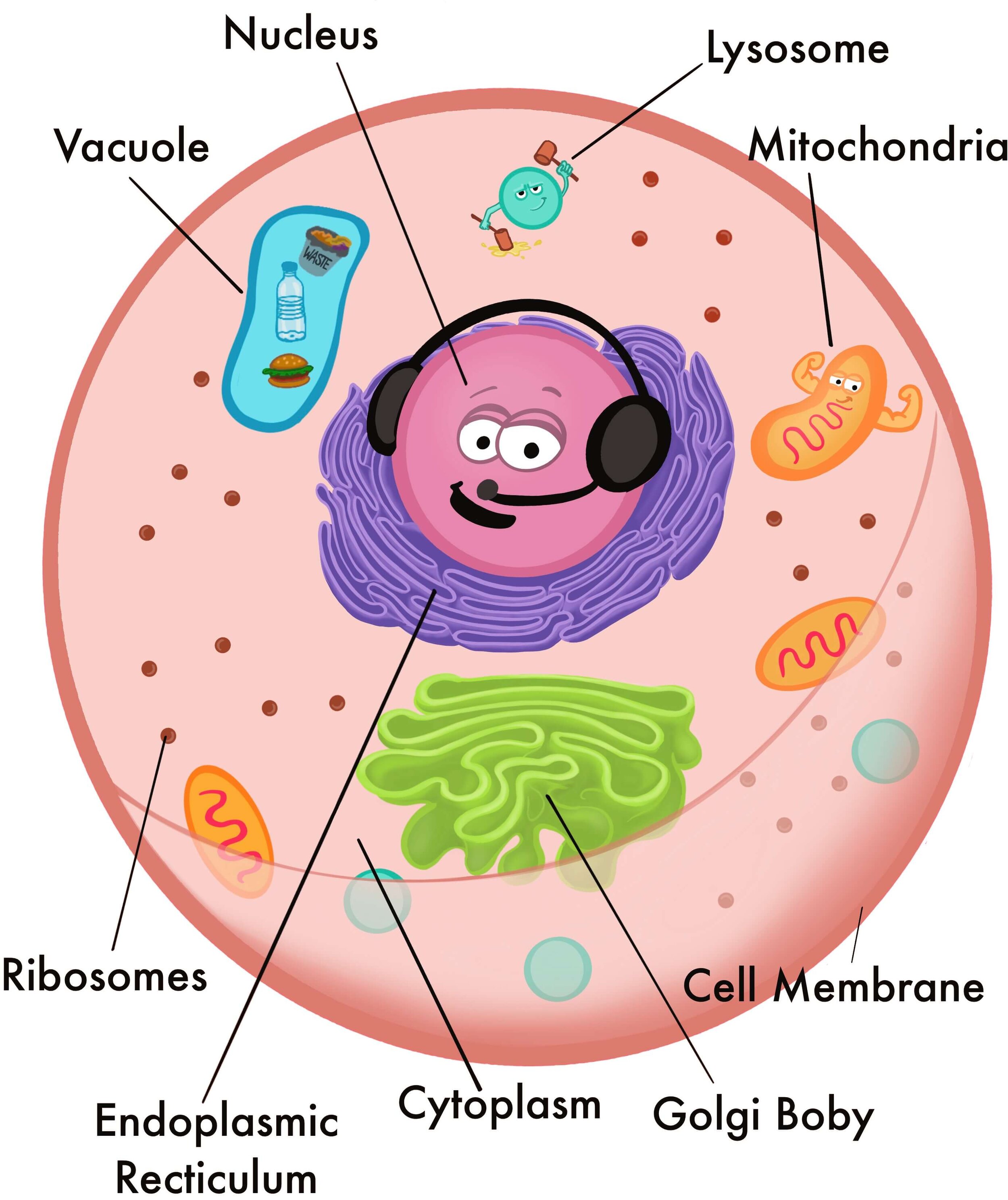
Let’s learn about the different parts of a cell and what they do!
All living things have at least one cell. Cells are extremely tiny, and can only be seen in a microscope. Your body has around 30 trillion cells! It was once thought that cells were very simple. However now we know that cells are extremely amazing, complex things— in fact, some people compare cells to an entire city where different things work together. There are various kinds of cells, and in this lesson we will learn about the animal cell and the plant cell. Here are the main parts of the cell:
Cell membrane is the outer coating that surrounds the cell. It is kind of like our skin. It allows things to move through, keeps things out, and protects the cell.
Cytoplasm is like the goo where all organelles float inside the cell. Organelles are like mini organs. Just like you have a brain, heart, and lungs, cells have different parts that help it function. Main organelles of a cell are nucleus, golgi body, mitochondria, lysosomes, ribosomes, and endoplasmic reticulum.

Nucleus
Nucleus is the cell boss; some people call it the cell brain. It contains all the DNA information of the cell. The nucleus tells the cell what to do, what to make, and when to divide. It is responsible for growth, cell division, making proteins, and differentiation (making the cell different and unique). It stores the mRNA, which are like messengers that communicate with the cell to tell the different parts what to do.

Golgi Body (also called Golgi apparatus) is kind of like a shipment center. It processes proteins and lipid molecules into packages called vesicles, and then transports them within and outside the cell. The Golgi body also creates lysosomes.


Lysosome
Lysosomes break down or recycle excess or worn out cell parts. There are often hundreds of lysosomes in a cell.

Mitochondria
Mitochondrion are the cell power makers. A mitochondria generates chemical energy to power the cell’s life giving chemical reactions.

Endoplasmic Reticulum
Endoplasmic Reticulum (ER) mainly transports proteins. The ER contains ribosomes that make the proteins. The ER then transports the proteins throughout the cell.
Ribosomes are protein makers. They are also cell organelles, but they are much tinier than the others. The ribosomes that float around in the cytoplasm make proteins for within the cell, and the ribosomes on the endoplasmic reticulum make proteins for outside the cell.

Vacuole
Vacuole is a place where the cell stores food, water, and waste. Plant cells usually have one or more large vacuoles. If animal cells have vacuoles, they are usually small.
Plant Cells

Plant cells have two things that animal cells do not— a cell wall and chloroplasts.
Cell walls help provide structure and protection for plant cells. It also works to filter things that come in and out of the cell. It is a thicker outer coating around the cell membrane.

Chloroplast
Chloroplasts help plant cells make food. Animal cells don’t make their own food, but plant cells do, so they need chloroplasts to help with the process of photosynthesis.
Cells are incredibly complex and wondrous! Some living things are made of only one cell, and some of trillions, but all living things are made of these incredible teeny tiny wondrous building blocks of life.
Or buy the Biology book!

Jolie Canoli Life Science workbook is packed with playful illustrations, easy to understand science lessons, playful quizzes, and educational activities. Perfect for elementary students studying Biology and Botany.
Botany Basics: Plant Systems

Plants are pretty amazing! If you have ever marveled at the beauty of a leaf, or wondered how a seed became a tree, then studying plants is a joy. This free pdf has a poster, study guide, science experiments, and a quiz all about plant systems! Photosynthesis is the plant process that uses sunlight to make food, transpiration is a cooling and water releasing process, and respiration is kind of like plant breathing, except they don’t have lungs to carry out the process.
If you live in the northern USA where the weather is already turning cold, you might want to do some experiments sooner rather than later… or perhaps a Christmas tree is the prime suspect for studying plant life! Whatever the case, I hope you enjoy this fun printable.
Enter your name and email, and then click the link provided to download your FREE PDF.
Enjoyed this lesson? Find more engaging lessons on botany and biology in the Life Science workbook!

Biology Basics: How Animals Reproduce
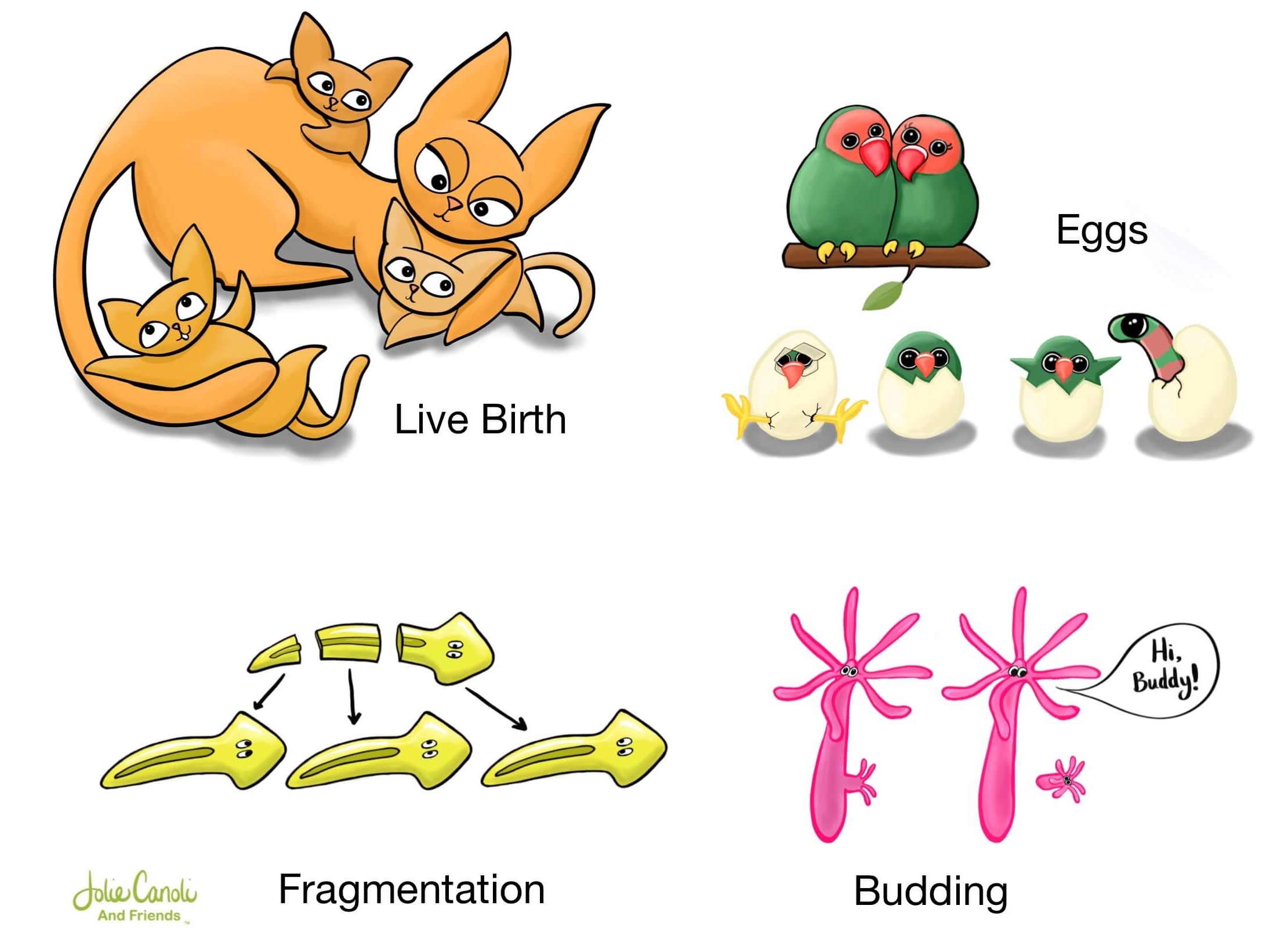
Two types of two-parent reproduction (sexual) and two types of one parent reproduction (aseuxual) are seen in animals. It seems crazy to think that animals can reproduce with only one parent, but with more simple creatures like worms and jellyfish, it happens!
Download the PDF for more a simple memory poster, fun facts and a quiz!
Two-parents Reproduction
Two parent reproduction ensures genetic variation in each new offspring. This makes for unique traits of each young, and allows for greater protection from disease. However the animals must find a mate in order to have new babies. The two types of two-parent reproduction are live birth and eggs.
Birds are the first thing I think of when I think of animals laying eggs. But many other animals lay eggs, too. Reptiles, Amphibians, Fish, and many invertebrates lay eggs. In fact, only Mammals give live birth!
One-Parent Reproduction
Most animals that reproduce asexually are simple creatures like invertebrates, like worms, jellyfish, and sea stars. Fragmentation and Budding can also be called cloning, because the offspring are identical to the parents. The advantage to asexual reproduction is that these animals can reproduce even if they cannot find a mate. However the offspring that are created have identical genetic information as the parent, and therefore one disease can kill off an entire population of cloned animals. They can also reproduce much quicker, but that means they can easily overpopulate and compete for resources.
These fascinating methods of reproduction make for some fascinating animal baby stories. Enjoy the PDF for more info!

LIfe Sciene Workbook
Enjoy illustrated lessons and playful quizzes on Animal Cells, Plant Cells, Classification of Living Things, Invertebrates & Vertebrates, Plant Identification, and more!
Browse by category:
- Book Reviews 1
-
Buddy Blog
7
- Apr 4, 2019 Buddy Blog Epidsode 5: Counting!
- Nov 22, 2018 Buddy Blog, Episode 4: Happy Thanksgiving!
- Nov 13, 2018 Buddy Blog Episode 3: Fall Leaves
- Oct 30, 2018 Here’s your guide to Pumpkin Everything— Recipes, Crafts, and Carving
- Oct 30, 2018 Buddy Blog, Episode 1: Exercise
- Jul 18, 2018 Fish Fashion 2018
- Jul 13, 2018 Orange You Tired?
-
Cooking with Kids
3
- Jun 3, 2019 Guiltless Peanut Butter Cookies
- Oct 26, 2018 Love Pumpkin Spice? Try this New Fall Favorite
- Aug 9, 2018 Goodness Granola
-
Earth & Space
2
- Nov 9, 2019 Astronomy: Comets, Oids, and Shooting Stars!
- Oct 9, 2019 Astronomy: Parts of the Sun FREE PDF
-
For Parents
15
- Aug 28, 2025 How a Little Engine Could, and You Can Too
- Jun 4, 2021 What Kids Learn From Reading At Every Age
- Apr 27, 2021 7 Powerful Picture Books to Make Your Child Feel Loved
- Feb 24, 2021 Words of Healing
- Oct 20, 2020 Words: Sticks and Stones
- Oct 20, 2020 You are Wonderful! Marzette- A Parable of Redemption
- May 4, 2020 "My house is a disaster!" Cleaning hacks so you can embrace the fun
- Apr 7, 2020 Help, My Kid Is Bored! How to Stop Whining and Cure Boredom Fast
- Nov 9, 2019 Homeschool Styles 101: Your Quick Easy Guide to Find What Fits Your Family
- Jun 3, 2019 5 Quick Ways to Invent Stories Your Kids Will Love
- May 27, 2019 Today is for Eternity
- Nov 10, 2018 Know nothing except... a lesson in teaching my kids
- Oct 30, 2018 Why Stranger Danger Doesn’t Work (And What To Do Instead)
- Jun 14, 2018 "Did you have fun?" Asking better questions
- Jun 12, 2018 Another day at the superstore
-
Life Science
8
- Apr 1, 2025 Botany Basics: Parts of a Flower
- Jun 5, 2021 Flightless birds? Swimming Mammals? How awkward vertebrates fit
- Apr 28, 2021 Biology: Animal and Plant Cells
- Nov 9, 2018 Botany Basics: Plant Systems
- Oct 16, 2018 Biology Basics: How Animals Reproduce
- Oct 8, 2018 Vertebrates- Animals with Backbones
- Sep 25, 2018 Biology Basics: Invertebrates
- Sep 7, 2018 Biology Basics: Kingdoms
-
Physical Science
4
- Jul 22, 2022 Astrophysics for Kids! 25 Easy Experiments to Do at Home
- Feb 24, 2021 Chemistry: The Atomic World
- Apr 8, 2020 Thermodynamics ...for Kids!
- Jan 24, 2020 Newtonʻs 3 Laws of Motion
-
Poetry
2
- Oct 20, 2018 Be Someone's Rainbow
- Jul 18, 2018 Bugs
- Science 3
-
Teaching Aids
3
- Nov 8, 2025 Explore the Nervous System: Cool Facts & Games for Kids!
- Jul 8, 2020 Phonics Fun for FREE
- Oct 21, 2018 How to draw a dog named Buddy