
Chemistry: The Atomic World
Meet those ever grumpy negative electrons, positively upbeat protons, leaping leptons, quacking quarks and more in this fun chemistry lesson that includes flashcards and build an atom printable.

Learn about atoms—the building blocks of the universe— with fun illustrations and examples that are easy for kids to understand and remember.
Get the full 12-page Chemistry PDF for $2.99 here
This colorful 12-page PDF include lessons on the parts of an atom (with a “build an atom” activity), what are quarks and leptons, what are molecules, and meeting the first 12 elements of the periodic table with corresponding flashcards!
or
Download the FREE 3-page Atom PDF by filling in the form below.
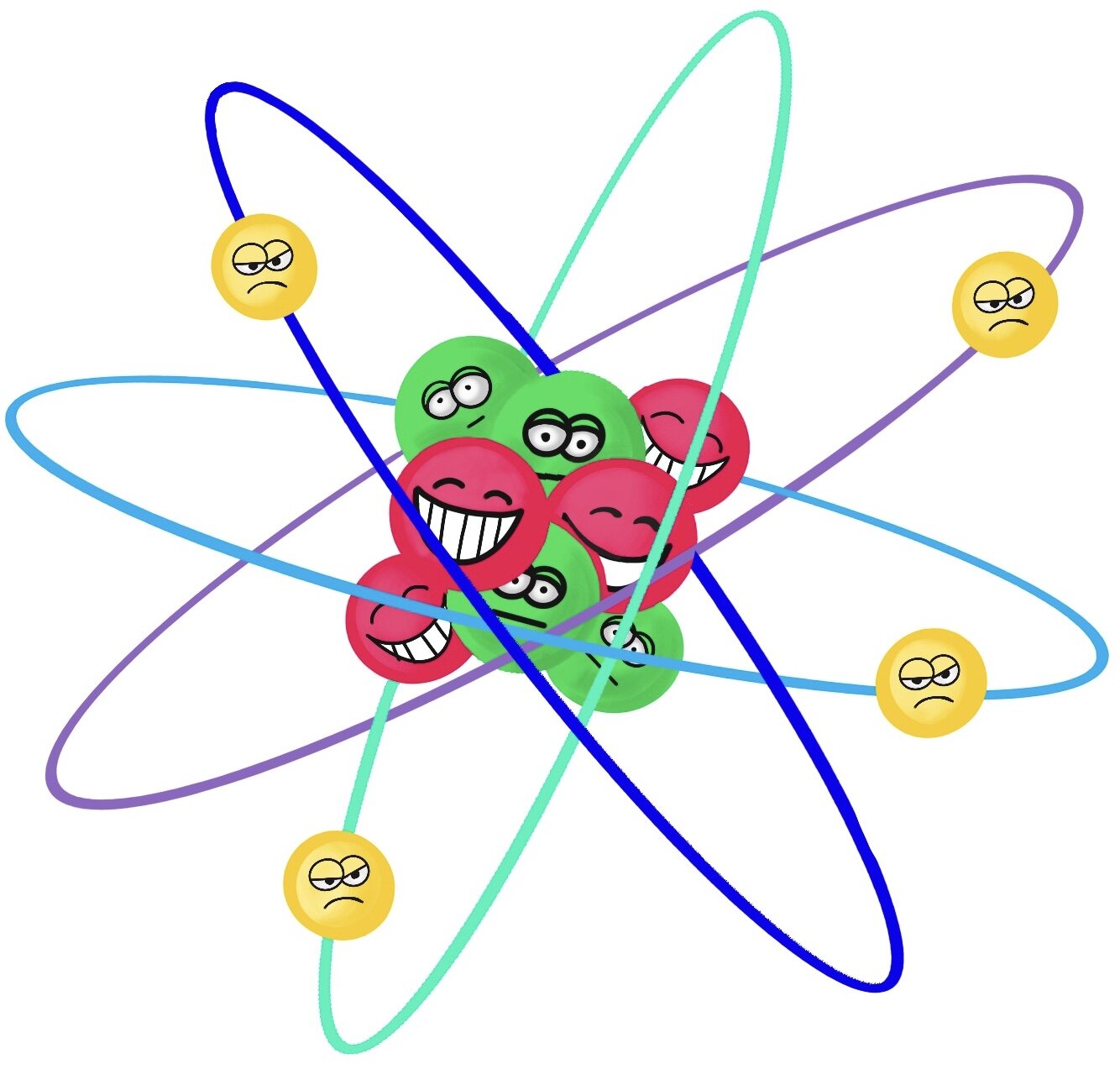
Atoms are the building blocks of everything we see! Atoms are so tiny that until a few years ago no one had actually ever seen them, even with a microscope! Atoms are so tiny that light cannot touch them, so they had to invent a different kind of microscope using parts of an atom to even see them! Your hair is 500,000 times wider than an atom. That is really small!
A Greek scientist came up with the name for the atom, the word “Atomos.” This word means “that which cannot be split.”
Imagine a tower of legos. The more you took apart the legos, the smaller the tower would become, until you only had one lego left. If you broke apart the lego, it would no longer be a lego, but only plastic bits. Atoms are like legos, the building blocks of matter. Like legos, atoms can combine with other atoms to form new things, but all ordinary matter is made of atoms. These atoms combine to form everything we see and touch— even the air!
Parts of an Atom
The basic parts of atoms are protons, neutrons, and electrons. The protons and neutrons form a tight ball in the center called a nucleus. The electrons zoom around the outside of the nucleus.

The nucleus is made of protons and neutrons. Protons are positive- see how they smile? They give atomʻs their identity. If the atom has 2 protons, it is helium. If the atom has 47 protons, it is silver. The atom can have a different number of neutrons or electrons, but the number of protons it has tells us what element the atom is.

Neutrons help protons stick together in the nucleus.
Neutrons act like a glue to keep the protons together. Opposites attract, and like charges repel, so if the positively charged protons were all pushed together, they would repel each other. The neutrons are neutral, meaning they have no charge, so they keep all the positive protons from repelling each other.

Electrons have a negative charge— see how negative they are with their grumpy faces? Electrons orbit the nucleus super fast. They are so fast that the electrons forms what seems like a shield around the outside of the nucleus.
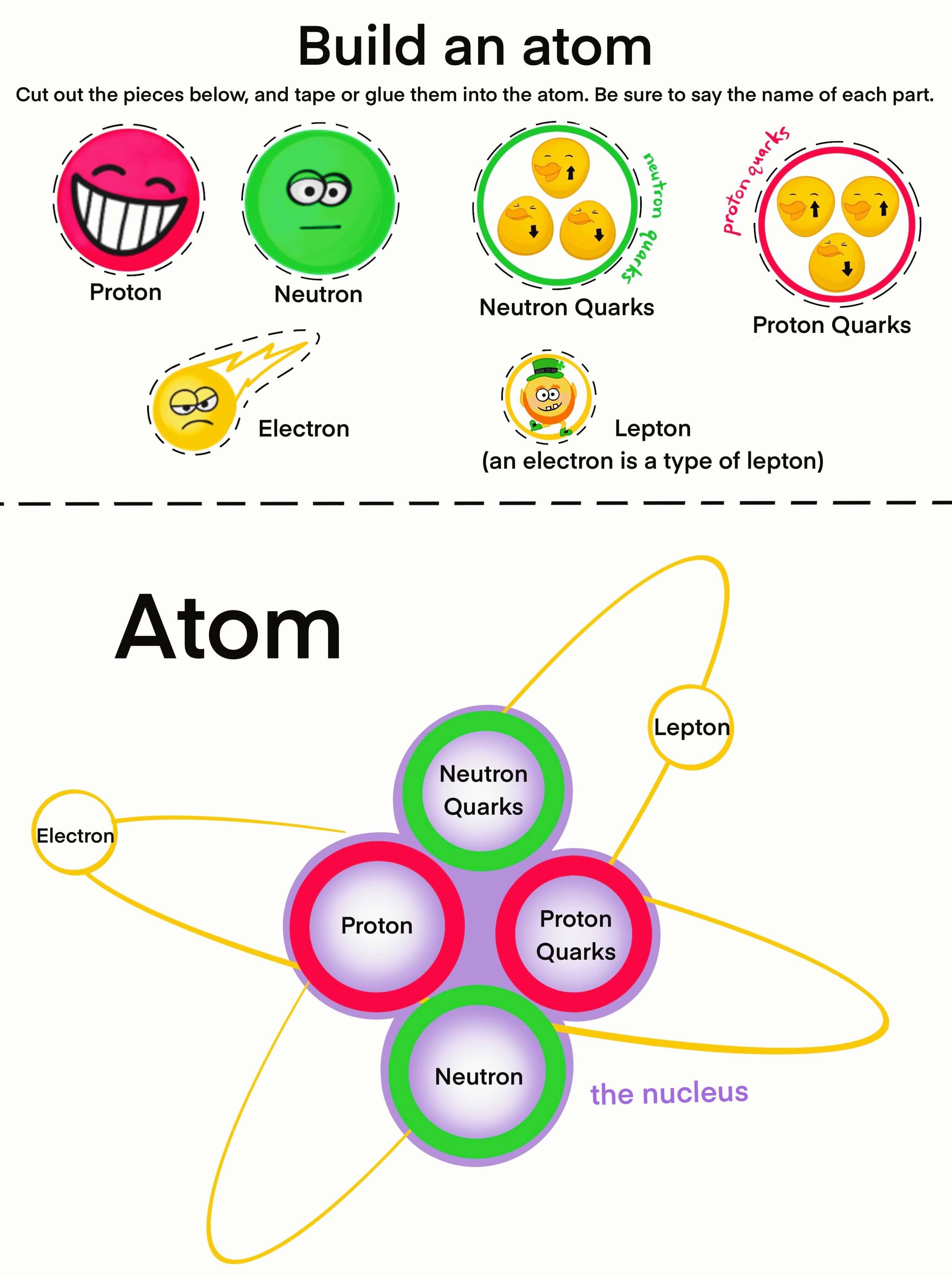
Electrons spin and rotate around the outside of the nucleus— kind of like planets orbiting the sun! As the electrons circle the nucleus, they travel at certain energy levels but can "jump" between different energy levels if they gain or lose energy.
Letʻs remember these names with some gestures:
Protons (smile and thumbs up!)
Neutrons (arms at your sides)
Nucleus (clasp your hands together),
Electrons (point your fingers and spin them in a fast circle in front of you.)
Zap-Pow! Try it!

Rub your feet on carpet.
You can make charged atoms. As you rub your feet on carpet, you pick up extra electrons from the carpet. This causes static electricity. If you reach for a friend after rubbing your feet on the carpet, you might feel a little zap. This zap is the electrons traveling from you to another place.
Rub a balloon on your head. When you rub a balloon on your head, you rub electrons off your head onto the balloon. The atoms missing electrons are positive, and the extra electrons are negative. These atoms have opposite charges, so they are attracted to each other. This will make your hair attracted to the balloon!

Click here to get the 12-page Chemistry PDF! Includes lessons on atoms, quarks, leptons, molecules, flashcards of the first 12 elements of the periodic table.
Newtonʻs 3 Laws of Motion

NEWTON’S 1ST LAW

An object at rest tends to stay at rest. An object in motion stays in motion at the same speed and direction unless acted upon by an outside force.
Newtonʻs first law shows us that nothing moves, changes direction, speeds up, slows down, or stops without something making it happen. Newton’s first law could be summed up like this: things want to keep doing what they are doing. Sort of like a kid that wants to keep playing with his toys, or a kid that doesnʻt want to wake up in the morning, objects in the universe want to keep doing what they were doing.

An object at rest stays at rest…
Imagine a ball sitting on the ground. Even though it is round, and easily rolls, it isnʻt going to move on its own. It will remain “at rest.” A little push, kick, or some other force, and the ball will move. Once the ball begins to move the ball would go one direction, and continue going that way, until something makes it change direction. If someone else kicks the ball, the ball hits something, or the ground is uneven, these things would affect the direction and speed of the ball.
If you kicked a ball straight up, this law says it would keep going straight up and never stop, right? Wait— thatʻs not what a ball does! It goes up, but then slows down, and falls back down. Why is that? Newtonʻs first law tells us that some kind of force must be making the ball change direction and speed. Do you know a force that would make the ball change speed and direction? If you guessed gravity, you would be right! Gravity is a force that is always at work on planet earth. But did you know that the ball would never stop if it was in outer space? As long as the ball never ran into anything, the ball would keep going in the same direction, at the same speed, forever.

So if you kicked a ball on the grass, would it keep rolling forever and ever and never stop? No, eventually the ball will stop. Why is that? Newtonʻs law tell us that a force must be responsible for making the ball change speed. Can you think of a force that makes the ball stop rolling? If you guessed friction, you were right! Friction is a force of two things rubbing together, and it slows things down. The ball rubs against the grass, eventually bringing it to a stop. If the ground was very smooth, the ball would travel farther than if it had to push through lots of grass or along carpet.
Now usually there are a lot of forces at work all at once, like gravity, friction, air resistance, and more. All of these forces affect how things move. Newtonʻs law is at work with everything, not just balls.
NEWTON’S 2ND LAW: F=MA

Newtonʻs second law is an equation! When we remember his second law, we can just remember the letters and an equal sign. But in order to understand Newtonʻs second law, we have to understand what those letter mean!
The first letter is F. F stands for FORCE. A force is a push or a pull. When we learned the first law of motion we talked about an “outside force.” That outside force is something that does something to an object- either pushing it, or pulling it.
The second letter is M. M stands for MASS. When I think of mass I think of the word “massive,” like “that is a massive elephant.” Mass is related to size and weight, but it isnʻt either one. We could say “the hedgehog has 1 pound of mass.” Or we might say “the hedgehog has 2 pounds of mass after it has eaten 800 jelly beans.” When we talk about mass we use measurements of weight like pounds, ounces and grams. The difference between mass and weight is that mass is a measurement without the effects of gravity.
For example, letʻs say you have a bowling ball with a weight of 12 pounds. If you take that bowling ball to the moon, it would have a weight of only 2 pounds because their is less gravity on the moon than on earth. The bowling ball did not change size or shape- the only thing that changed was the amount of gravity that pulls on it. But the mass of the bowling ball would never change. A bowling ball with a mass of 12 pounds on earth will have the mass of 12 pounds on the moon! Mass is the amount of atoms that a space fills.
Can you guess why does Newton uses mass instead of weight? Well, Newton was pretty smart. He knew that if he used mass, then his law would work anywhere in the universe. So this equation: F=MA will work on the moon, on Saturn, in a spaceship, or deep underground.
The last letter in this equation is A. A stands for Acceleration. Acceleration is an increase of speed, or velocity. If a rocket ships accelerates, it goes faster. If a rocket ship loses acceleration, it moves slower.
If we put all these letter together, we get this sentence:
Force equals Mass times Acceleration.
Newton’s 2nd Law law tells us several things with just three letters!
It tells us the greater the mass an object has, the greater the force is needed to make it move.
It tells us when a force acts upon an object, it makes it speed up, or accelerate.
It tells us the greater the force, the greater the acceleration.

If this elephant uses enough force, it can get this massive truck of farm animals to accelerate!
When we have this equation we can find use it to discover how much force weʻll need to get something to move, or how fast something will go, or how heavy something might be, or how much more force weʻll need to make in order to go a certain speed. It helps us with all sorts of things! So if I knew a walrus wearing a wedding gown in a wagon was 100 pounds of mass, and I used 300 pounds of force, I could make the walrus wearing a wedding gown in a wagon go 3 times faster.
NEWTON’S 3RD LAW
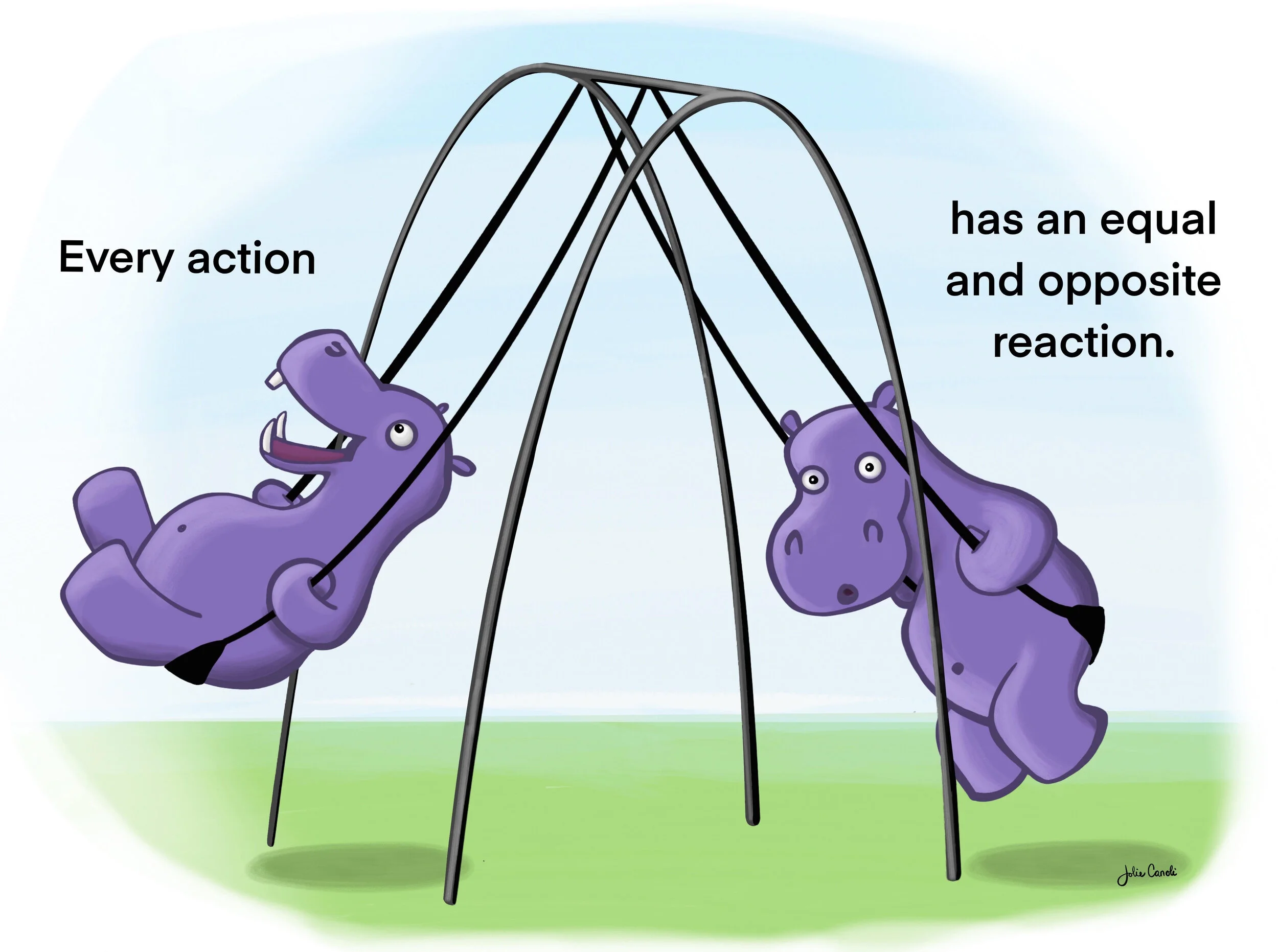
Every action has an equal and opposite reaction.
To understand Newtonʻs third law, letʻs think of some actions, and how they have equal and opposite reactions! Letʻs start with pushing a box of toys. When you push a box of toys, the box pushes back on you with an equal and opposite force. You can tell it is pushing back on you because you can feel the pressure in your hands, and the weight of the box.
Now imagine you are sitting on a swing. Your mom or dad pushes you. You fly forward and up! But now your swing is going to go in the opposite direction- backwards and down. Back and forth, until the force of gravity and friction of the air makes you slow down- and you ask for another push!
When your mom and dad push you, their action is equal to how high you will swing. If they push you with a lot of force, you will go very high! If they push you with very little force, you wonʻt go very high at all. The bigness of their push is equal to the bigness of your swing!
So now letʻs put the story of swinging into Newtonʻs law.
Every action (big push) has an equal (big swing) and opposite reaction (away from mom).
Every action (little push) has an equal (little swing) and opposite reaction (away from dad).

Now letʻs think of shooting a bunny out of a cannon. The explosive force of the cannon shoots the bunny out of the cannon. The cannon will have an equal and opposite reaction of being pushed backward as the bunny is pushed forward.
Now imagine you are an astronaut in outer space. There is nothing to push; but you have a canister full of gas. You open the gas tank, and the gas escapes. The pressure of the gas moving out of the tank will push you in the opposite direction with an equal amount of force. The gas will flow one way, and because of the force of the gas escaping, it will have an equal and opposite reaction— pushing you away.
This law is at work with every action in the universe! Whatever you push or pull is also pushing or pulling back on you. Even in the simplest things, this law is working. For example, if a book is sitting on a table, the table is pushing back on the book with an equal and opposite force, keeping it from falling through the table. If you are sitting on a chair, the chair is pushing back on you, keeping you seated. Take a look around you. Can you think of some examples of this law at work around you?
Yes please! I’d like a Free PDF! (Includes 3 posters, lessons, and a review quiz.)

Astrophysics for Kids!
Your kids will love learning about the moon, sun, stars, laws of motion, thermodynamics, and more!
Homeschool Styles 101: Your Quick Easy Guide to Find What Fits Your Family
Montessori, Charlotte Mason, Classical- what works for you? There are a million way to teach children. Learning homeschool styles will help you navigate homeschooling lingo and find what fits you and your family best. Here’s your playful introduction to homeschool styles.

So you've decided to homeschool. It is a wonderful, challenging, rewarding, and slightly terrifying journey. You will learn to trust and let go, to press forward, to breathe, to fall in love with learning, and most of all, to fall in love with your children in more ways than you knew you could.
Remember This
Before we begin, let’s remember what we are looking at.
Style.
A style is a way of doing, that has certain methods and trends. Some may look cleaner, neater, or even better, but it still remains style.
Some of us are diehard style people. The people that feel at home in plaid pjs at night and plaid button up shirts in the day in a rustic cabin complete with wall mounted bucks and wooden ducks on the mantle. Others of us wear yoga pants and crocs because it’s comfy and we aren’t planning any outdoor activities.
Neither are wrong, but they both express a style. One, very vividly woodsy, the other, relaxed and swayed with what is needful.
When we think of homeschool style, we are looking at various methods of learning. People learn in many ways. Some ways are easier, some carry more joy, and some are described as “the worst” by your 5th grader.
So what style is best? Will my style ruin my children? Is this 19th century education expert better than the ancient Greek method? Does this Italian woman have more wisdom than the curriculum experts at that homeschool conference? WHAT SHOULD I DO?!?
Maybe start by asking these two questions.
What style is best for my family?
What style is best for me, the homeschool parent that has to DO the prepping, teaching, and training?
Remember: Homeschool is learning at home.
That means that your environment is your family, and often that family lifestyle and choices will sway you in a direction for what fits you. Find the freedom in learning within your home. No one is going to judge you more than yourself, so let go of any expectations of achieving a homeschooling style that looks perfectly like someone else. It can’t. Your family is unique, and your homeschool will reflect that. In fact, it should reflect that.
Maybe you love baking. Grab those kids and bring them alongside you so they can learn fractions with brown sugar and baking soda.
Maybe you love knitting. Extend your wisdom to your little one's fingers, teaching them dexterity, pattern, and the engineering required to make that sweater.
Don’t be afraid to find your own unique homeschool style, even as you admire and make use of the wisdom of those before us.
The Styles
Here's your tongue-in-cheek initial baptism into the waters that is homeschool styles.
Interested in taking a quiz to find what fits you? Try this quiz from Homeschool On.
Unschooling
Unschooling is not equivalent to unlearning. My assumption was that this was a method of trying to make your kids dumber. It is not, so don't worry-- you don't have to call social services on families that practice this.
Unschooling is a terrible-sounding term for passion-led teaching. Is your kid interested in robots? Let's study robots! We'll learn the in and outs of electricity and power sources, motors, gears, technological advances, all while reading great books on the subject and writing about it, too.
The teachers of this style often reject “school” in its current form. They critique school as a system meant to create an obedient workforce. They prefer to nurture the creative and curious mind.
The premise is that children are naturally drawn to learn, and so rather than feed them through a system ("school") of learning in various unrelated subjects, the student will naturally be more inclined to learn and study and grow in all areas of education when they are pursuing their own interests. Of course, mom helps them to dig deeper and challenges them, but overall the child is driven by their passions, and studies are navigated by whatever seems most intriguing and not by fulfilling specific curriculum or criteria.
So you want to do experiments all day? Ok, sure! Why not! So you want to read every book on the Trojan War? Lookout library, here we come! All you care about is your TV show? Let's find out how it was produced! This is basically compulsive obsessive disorder as a homeschool style.
Check out this awesome article about How to Unschool.

Montessori
For some reason every time I think of Montessori I think of spaghetti and an abacus. Montessori method is a combination of age-appropriate learning, wooden blocks, and interpretive dance. So think Dorothy Sayers meets Martha Graham in a log cabin. (Pretty much nobody knows what I'm talking about so I'll explain more.)
Montessori’s methods are applied in preschool and elementary years. Kids are encouraged to touch, discover, and experience the world around them, learning as they go.
Be forewarned, many images of this method are Pinterest-able and Instagram-able, but you don’t need to buy thousands of wooden toys to make this method work. In fact, Montessori sought to educate poor children.
Montessori’s writings are the best place to start in understanding her style. She believed children developed in particular ways, and have certain innate characteristics that drive their educational interests. These interests should be fostered in a welcoming environment to learn, including a natural, tactile, and movement-friendly space. Teachers pay attention to a child's interests and abilities to help them in their natural growth. Montessori provides a whole philosophy of education and won a Nobel peace prize, so if you follow her methodology you can brag about that like you're a boss.

Charlotte Mason
This lady is from the 19th century and has six huge volumes on education that are so old-school that it's a little like reading Shakespeare without a good love scene. There are books about her books that try to summarize her philosophies with modern day language and examples.
Charlotte was a teacher, and from personal experience with children became convinced that kids need to play outside and read old books.
Here is where we get the term "twaddle." Twaddle is the opposite of "living books", which are basically old books.
I’’m kidding… sort of. Seriously though, living books are books which possess deep characters, beautiful language, and wholesome content. Twaddle is the Charlotte Mason curse word for lousy reading material that will rot your kid's brains.
Charlotte Mason followers offer pretty delightful book lists for all grade levels, such as these:
Literature by Grade Level from Charlotte Mason Home
Living Books Lists from Our Journey Westward
Mason’s method seeks to develop character as well as the mind. She particularly valued being outdoors, and believed that children must get at least an hour outside a day. She asked parents to use the outdoor time to study nature, growing in careful observance and admiration for bugs and junk. Personally I find her writing to be enchanting. Her deep care for children accompanied by her overall regard for their growth of character alongside intelligence is powerfully motivating. I'm a Mason groupie. You can find free curriculum plans for her method here.

Classical
Classical education is a method of learning that sounds like wearing togas and debating Socrates at the Parthenon.
However it is actually a language centered education that includes learning Latin, being a history buff, and having eloquent conversations like Socrates and Plato (toga optional).
This method values critical thinking, sound logic, reading great works, and learning subjects now dubbed "archaic” that uniquely develop the brain and expand understanding (e.g. Latin, cursive handwriting, etc.). Purveyors of classical education tout the importance of learning how to learn, recognizing that if one is equipped in how to properly learn, they can learn anything.
Classical Conversations (CC) is a whole method unto itself and is primarily co-op based. Younger students are good at memorization, so they have them memorize with dance moves, chants, and a 13-minute Timeline song. In middle school students diagram sentences and write charts until their wrists sound like rice grinders. Then in Challenge, which is kind of like high school, and they read a lot of great books and finally learn why they memorized a billion facts. Kids study all the core subjects (or what true classical nerds call the Quadrivium), including Latin and Cartography so they can sail around the world like a medieval boss.
I personally loved Classical Conversations co-op, and while I have departed their method for various reasons, I still use some of their memory work in my homeschooling from time to time.
Classical conversations should include a glossary. Here’s mine.
Trivium: The three stages of learning, classified by Plato himself, namely Grammar, Dialectic, and Rhetoric.
Grammar: The first stage of learning, wherein students learn the language/terms of the subject. “Pasgetti.” No, Spaghetti. This is also where the term “parrot” comes from. Dorothy Sayers eloquently compares this stage to an annoying bird who copies everything you say.
Dialectic: “Why, why, why??!?” This is the questioning stage of learning, aided by inquisitive minds.
Rhetoric: “I’m a know it all, so blah blah blah!” Now the student has a basic understanding, so students formulate their own opinions and ideas, and express them. (AKA teenager.)
Stick in the Sand: This is not a metaphor for being stubborn. This is a summation of a pep-talk to not overthink or over complicate a child’s education— meaning you can teach a child anything with just a stick and sand. (You don’t even need pencil and paper!) “I bought six books, 15,000 blocks and rainbow streamers to teach math, and I’m so overwhelmed with homeschooling. What should I do?”
Pep-talk reply: “Stick in the sand.”
Let children flourish in their stage of development
Unit Studies
This homeschool style is equivalent to the phrase “beat a dead horse.” Unit studies take one subject, say a dead horse, and study it in every way imaginable. Sometimes this even includes math. “How many times did you beat the horse until you knew it was dead? Multiply that by 7.”
The amazing thing about unit studies is how one can study a single subject for several weeks, with various methods, and still find more fascinating things to learn. Unit studies demonstrate the very thing about homeschooling we so often forget — we can never learn it all. For that reason learning to learn is a beautiful journey, and many unit studies tap into this journey with playful and creative challenges.
For instance Five in a Row is a popular homeschool curriculum that functions like a unit study on a favorite book. They provide studies that explore the geography, history, science, and even math related to the book.
You can find reviews of various unit studies here. Often unit studies are sold as curriculum downloads or packets, but sometimes parents will create them as they go.

Traditional
This is doing school-school at home. Some people even buy school desks, and have a bell, and lecture their students like normal regular school teachers. I’m all like, “I have a couch, and that works.”
And many traditional homeschoolers actually agree- a couch is a cozy place to school.
Traditional schoolers are those who like to keep on-track with traditional grade levels and achievements. These are often the people who purchase the full curriculum packs, and following the step by step instructions that are provided. This is actually a wonderful solution for many families, because they know they will cover everything that most schools cover, and it gives parents the assurance of following through with federal or state standards for any given grade. Parents also know that if their child needs to go back to a private or public school that their child will enter their grade confidently.
Some beloved traditional schooling curriculums include Abeka, Sonlight, Good & the Beautiful, and Saxon. Check out these recommendations:
Full Curriculum Christian Options — from Homeschool-Curriculum.org
Secular Homeschool Programs — from Love to Know
encourage a love of learning

Eclectic
If this homeschool style were pants, they would be crazy pants. Really colorful, lots of polka dots, zig zags, and a little lace.
This homeschool style is often practiced by the mom that wants to have it all, and therefore picks a math book from this company, a science book from this other place, and history from another. They sometimes embrace many different styles, and chose what seems to work best for either their teaching style, or their child’s learning style. I am pretty sure I am this one, and I would really like to wear these pants.
Being eclectic means that you like to choose what fits each child best. Maybe you tried Saxon math and you realized your child needed a more hands-on math curriculum. Or you really love the classical history lessons from The Story of the World but you want a more Charlotte Mason style approach to language arts. These people find their way with what fits the best.

build character as much as brain power
Road-Schooling, World Schooling, Farm Schooling
Do you live on the road? Perhaps an RV? Or perhaps you live on a farm? Some families take a year off— like high school graduates going backpacking through Europe; except the backpack carries a toddler and they probably have a jogging stroller loaded with granola bars. These brave souls explore various countries and literally use the world as their classroom.
Traveling the world is a fantastic way to learn so much— culture, language, etiquette, history, and more. It can be expensive, but if possible, it is an enriching experience that would shape young minds for a lifetime. This method is achievable by those who work remotely, have a large sum of money stashed away, or have a lot of friends world-wide that are happy to host your rambunctious family.
Roadschooling is similar, but it tends to be centered in a single country. These people own RVs, are happy with simple living and tent camping, or travel a lot. They use the places they visit to build their curriculum is in history, sciences, and nature. Parents can use libraries on their stops to fill up on reading materials related (or not) to their location. Check out some steps to roadschooling here.
Farmschooling is modern day Little House on the Prairie without having to deal with mean ol’ Nellie Olson. Chickens are teachers, cow the principal.
Seriously though, kids who live on a farm learn a vast amount of life skills, especially when parents are intentionally invested. From learning how to fix a tractor to agriculture, animals sciences, botany, and landscaping, these kids are immersed in a full college degree on farming. Parents take the time to help their children understand the whys and how behind a successful farm, growing life skills while learning how to learn.
A similar method is called Moore. Named after Raymond and Dorothy Moore, this method says kids should not start formal schooling until at least the age of 8. It emphasizes stress-free learning by not overtaxing younger children with lower attention spans, allowing kids to read books related to their subjects rather than be driven by textbooks. They encourage manual work as much as study, and serving in the home or community at least an hour a day. Thus if you own a farm or a family business, this method validates your kids milking the cow just as much as doing their multiplication tables. They believe all this hard work, service, and interest driven learning makes kids happy creative geniuses that will take over the world.
The Take Away
Despite the many styles, there seems to be overarching similarities in homeschool styles— namely a desire to help children flourish in their God-given developmental stages, encouraging a love of learning, and building character as much as brain power. These are all things that parents can rally around.
Secondly there is a profound current of "no worry" that is emphasized in all these styles. Certain structures in educational systems are rejected in favor of creativity, and joy in the process. I've yet to encounter a homeschool system that says "you're not doing enough!" Ultimately your love and deep care for your child's success will be the determining factor in ensuring a good education.
Overall, if a homeschool style doesn't fit, don't do it! Style is just that— style. If you find that a certain style or curriculum aligns with your values, embrace it, and enjoy it! You know your child best, and you will learn together.
Browse by category:
- Book Reviews 1
-
Buddy Blog
7
- Apr 4, 2019 Buddy Blog Epidsode 5: Counting!
- Nov 22, 2018 Buddy Blog, Episode 4: Happy Thanksgiving!
- Nov 13, 2018 Buddy Blog Episode 3: Fall Leaves
- Oct 30, 2018 Here’s your guide to Pumpkin Everything— Recipes, Crafts, and Carving
- Oct 30, 2018 Buddy Blog, Episode 1: Exercise
- Jul 18, 2018 Fish Fashion 2018
- Jul 13, 2018 Orange You Tired?
-
Cooking with Kids
3
- Jun 3, 2019 Guiltless Peanut Butter Cookies
- Oct 26, 2018 Love Pumpkin Spice? Try this New Fall Favorite
- Aug 9, 2018 Goodness Granola
-
Earth & Space
2
- Nov 9, 2019 Astronomy: Comets, Oids, and Shooting Stars!
- Oct 9, 2019 Astronomy: Parts of the Sun FREE PDF
-
For Parents
15
- Aug 28, 2025 How a Little Engine Could, and You Can Too
- Jun 4, 2021 What Kids Learn From Reading At Every Age
- Apr 27, 2021 7 Powerful Picture Books to Make Your Child Feel Loved
- Feb 24, 2021 Words of Healing
- Oct 20, 2020 Words: Sticks and Stones
- Oct 20, 2020 You are Wonderful! Marzette- A Parable of Redemption
- May 4, 2020 "My house is a disaster!" Cleaning hacks so you can embrace the fun
- Apr 7, 2020 Help, My Kid Is Bored! How to Stop Whining and Cure Boredom Fast
- Nov 9, 2019 Homeschool Styles 101: Your Quick Easy Guide to Find What Fits Your Family
- Jun 3, 2019 5 Quick Ways to Invent Stories Your Kids Will Love
- May 27, 2019 Today is for Eternity
- Nov 10, 2018 Know nothing except... a lesson in teaching my kids
- Oct 30, 2018 Why Stranger Danger Doesn’t Work (And What To Do Instead)
- Jun 14, 2018 "Did you have fun?" Asking better questions
- Jun 12, 2018 Another day at the superstore
-
Life Science
8
- Apr 1, 2025 Botany Basics: Parts of a Flower
- Jun 5, 2021 Flightless birds? Swimming Mammals? How awkward vertebrates fit
- Apr 28, 2021 Biology: Animal and Plant Cells
- Nov 9, 2018 Botany Basics: Plant Systems
- Oct 16, 2018 Biology Basics: How Animals Reproduce
- Oct 8, 2018 Vertebrates- Animals with Backbones
- Sep 25, 2018 Biology Basics: Invertebrates
- Sep 7, 2018 Biology Basics: Kingdoms
-
Physical Science
4
- Jul 22, 2022 Astrophysics for Kids! 25 Easy Experiments to Do at Home
- Feb 24, 2021 Chemistry: The Atomic World
- Apr 8, 2020 Thermodynamics ...for Kids!
- Jan 24, 2020 Newtonʻs 3 Laws of Motion
-
Poetry
2
- Oct 20, 2018 Be Someone's Rainbow
- Jul 18, 2018 Bugs
- Science 3
-
Teaching Aids
3
- Nov 8, 2025 Explore the Nervous System: Cool Facts & Games for Kids!
- Jul 8, 2020 Phonics Fun for FREE
- Oct 21, 2018 How to draw a dog named Buddy