"My house is a disaster!" Cleaning hacks so you can embrace the fun
7 cleaning hacks for busy parents! Creation and discovery is messy— I share my favorite methods to contain the mess while maintaining joy.
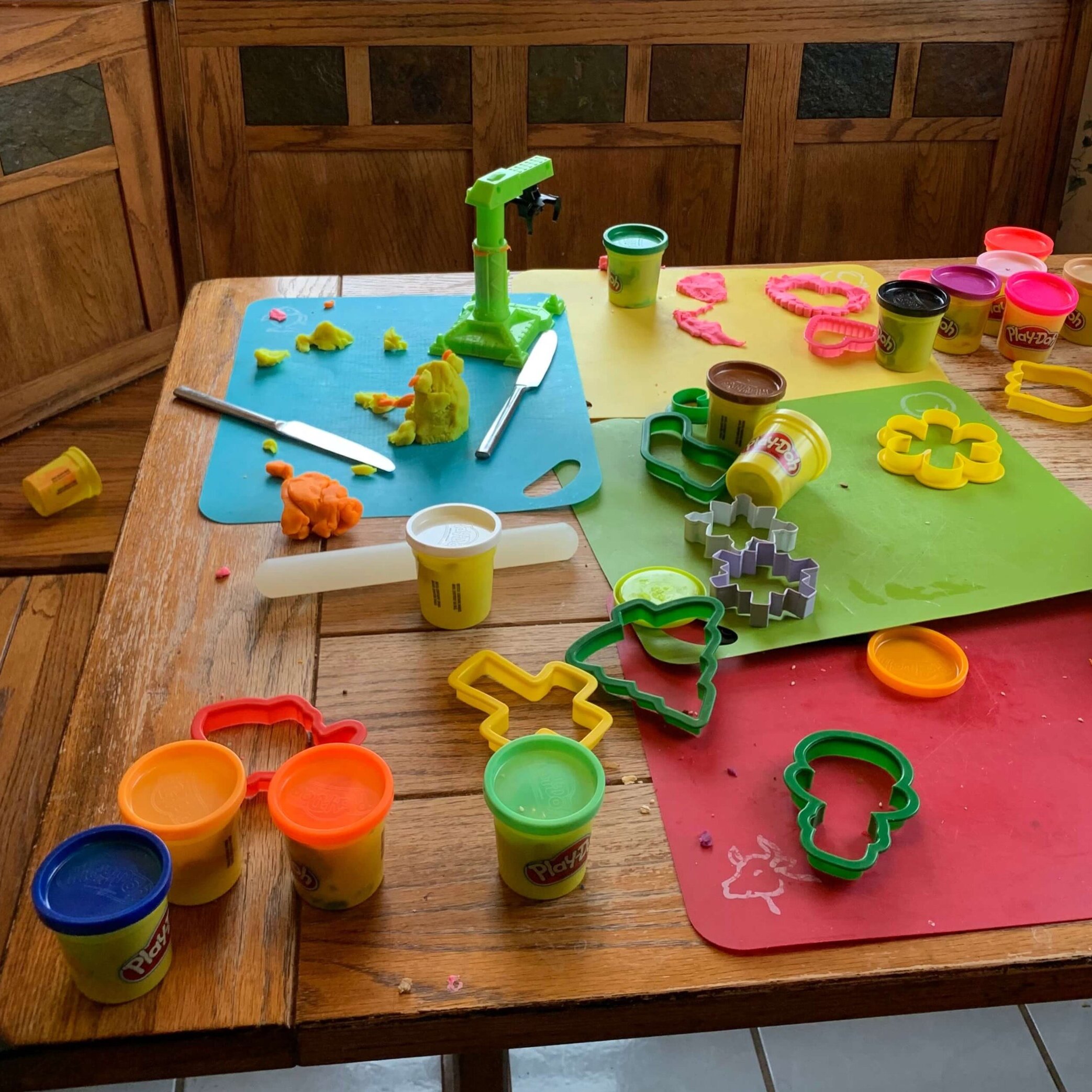
Expect the mess. Embrace the fun.
I spent 5 years homeschooling all of my children, the most recent being with a 9 year old, 7 year old, 2 year old, and a baby. We found a rhythm and method that suited us, but my house felt in a constant state of MESS. Clean up was always followed by a new mess. Mess, then mess, then another mess, followed by more mess, with cleaning sprees between.

Then my older children were able to attend a local school for the year that really suited them. School started. A week went by. The mess was manageable. A month later I was wondering what happened. Still at home with my then 3 year old and toddler, I was discovering this— the less little people, the less mess. Granted my two kids could still make a spectacular mess. But there is a reality to the footprint each child leaves in the home— whether it be a literal footprint of mud and smashed raisins, or the noise imprint of extra humming, or the crumb imprint left on my kitchen floor— the more, the messier.
Cleaning is a beautiful thing. Order is important to health, peace, harmony, and beauty. We must strive to create homes that offer functionality and honoring of one another. Yet for the sake of clean home I often sacrifice all the things a clean home offers- peace, harmony, beauty, honor. I scream “clean up this mess!” so I can have a peaceful home. I interrupt harmonious play and peace for visual order.
We can have both peace and cleanliness, but we must expect the mess. Without a little mess there will never be muffins baking in the oven, an original painting on your refrigerator, or memories of reading in a fort.
Neil deGrasse Tyson shared a brilliant thought that has stuck with me- want scientifically literate children? Get out of their way. Tyson encourages parents to let children explore, try new things, and yes- make a MESS. If we want creative kids— kids who will grow up to be engineers, scientists, explorers, artists, and innovators finding new solutions, then we need to allow them to make a mess. The mess is where creation takes place.
“Clean is a beautiful thing
—order, peace, harmony—
But mess is where creation takes place. ”

So if youʻre looking for cleaning hack, these are my favorites for families. Just don’t let clean determine your identity, or whether you can have peace.
Cleaning Hacks for Kids at Home
These are my favorite cleaning hacks that have saved my sanity and given me freedom to EMBRACE THE FUN! Hopefully these help you maintain a beautiful, ordered home that still allows you to enjoy your children in the midst of play.
Make a Mess— clean it up before you make a new mess
Simply put, if you make a mess, clean it up. The kids can go bonkers with science experiments because they will help you clean it up. The kids can play with the pots and pans because they will load them in the dishwasher at the end. If they forget (because they will), help them backtrack and clean up the first mess… before continuing with their current mess. Because if you want your kids to be creative and have fun, they will make a mess. Guaranteed.

Have an explosion room
Most people call this room a playroom, but it really is an explosion room. I have met several parents that allow their kids to have a space that is nearly a constant mess. This is where all the toys are free to dangle, pile, hide, and blockade the space at all times. If you have a space in your house where you can create this, it can be a true stress relief for parents. It eliminates a lot of toys from messing the rest of the house, and provides a space where the kids can just get playing without tip-toeing around you.
7 Minute Cleanup
Everyone in the house takes 7 minutes to tidy up the house. You can even set a timer. Everyone drops everything that they are doing and starts cleaning! Youʻll be amazed at what a difference just 7 minutes can do. It can also be helpful to do a quick delegation- Robert, you take the Kitchen. Sarah, you do the living room. Billy, you put away the toys. Once the timer goes off, everyone can go back to doing whatever they wish.
I found this helps keep the house in order when little forgotten messes start to accumulate. I also find that the time short limit really helps the kids keep a great attitude. They know the task has an end, and itʻs not too far off, so they can work joyfully without complaining.
Snack Hack
My kids love to snack. They also find ways to drop food and smash it into my rugs. The constant access to food without limitations has created problems for me. Choose a dish and allow your child to choose three snacks for the day. These are their snacks for the whole day. They will still get the standar three meals a day, but they canʻt go looting the refrigerator or cupboards throughout the day, because their snacks have already been chosen.
Give away, Throw Away, Store Away
Many families have an endless supply of toys. Children easily get distracted and move on to the next thing. Limiting their toys really helps contain their messes. Get a bin or two, and store sets of toys in them. Make sure the toys you leave have some favorites, and the toys you store have some favorites. Then one day, bring out the stored bin. Suddenly the kids have new toys! Donʻt forget to pack away the toys they were playing with and store them for another surprise toy unveiling in a few months.
As for our toys and things, simplicity can breed creativity too. Ask yourself- do I love this, need this, and use this? If not, give it away, or throw it away. The less things we have, the less we have to clean and worry about.
Create No-Mess Spaces
I need this hack in my life. Currently there are collections of junk on nearly every surface in my living room. If it is a clear space, like a counter, mantle, top of a bookshelf, or a table, people will find a good reason to leave junk on it. By creating no-mess spaces you can eliminate a sense of constant clutter. If someone leaves a mess on a no-mess surface, declare a person to clean up the mess (hopefully the person who was most responsible). They must put everything in its proper place.
A Place for Everything, Everything in its Place
Many moms and parents around the world would probably tell me “Duh. This is so basic, Jolie.” But for whatever reason this was not basic for me. By recognizing that my things were lacking homes I have been able to identify the problems of many messes in my house.
Just say that phrase— place for everything, everything in its place— and you will begin to see the things that are missing places, and things that are in the wrong places. The cure for clutter becomes evident. Lacking an organizational mind, this has helped me identify what actually needs organization in order for my things to have a place.
Kids are notorious for not knowing where something goes and therefore not putting it in the right spot. Guess how they learn? By cleaning. If you are always doing all the cleaning, your kids wonʻt know where these places are. I have a friend who will never let her children load the dishwasher because her kids wonʻt do it right. Well, they will never learn if they are never given the chance to learn. Let them be creative, but also let them take responsibility for their creativity.
No Mess, No Fun
There is a proverb that says “Where no oxen are, the trough is clean; but increase comes by the strength of an ox.” In other words, want a perfect home 24/7? Don’t live there. We want homes full of life, experiences, play, and joy! So let loose, and let messes happen. We can always clean up afterwards.
Help, My Kid Is Bored! How to Stop Whining and Cure Boredom Fast
Bored kids? Help them stop whining with these fun “bored stick” ideas.


Summer begins and kids are like dogs being taken for a walk— little bodies wiggling, squirming, and running free!
Summer is freedom!
Summer is joy!
Summer is the best!
A few weeks pass... they slow to a putter. Toys lose their luster. They drag their miserable bodies to me and moan, “I’m bored.”
Awww, poor you. I wasn’t sarcastic, folks. I was genuinely compassionate. I suggested ideas. They knocked them down. Finally one idea sticks. But day two, three, and four of the I’m bored mantra continues.
“Uggghhhh. I’m SOOOOOO BORED.”
Aww, poor you. Sarcasm was running thick. What once appeared as a request for creative input became whining that screeched in my ears and yanked on my patience. My kids were irritated, I was irritated, and my kids were irritated with my irritation.
Then I implemented the Bored Jar.
It was priceless.
In fact it was almost like magic. My kids stopped whining almost instantly. When a whine did manage to pop out, I had an instant solution. And so did my kid.
Here’s the thing. It doesn’t always cure boredom. In fact, sometimes it is like a consequence for whining. What it DOES do is quell the mantra and get your kids doing something.
But you have to stick with the plan. You will learn how to make your jar. It will be a lifesaver. It will stop the whine. Your kids may actually be happier. But it only works if you stick with the plan. No exceptions.
Make the Jar
Grab some paper, or popsicle sticks, or 3x5 cards, or strips of paper. Write out between 10 to 20 activities. I have a printable list for you, but you can create your own. I strongly suggest having a mixture of fun things and work-related activities. This gives a fun tension of “what am I gonna get…” to the whole ordeal. And honestly, doing a little helping out around the house can give kids much needed purpose in a boredom phase.
Once you’ve written out your activities, pop them into a jar, cup, or basket, and announce to your children the new addition to your home- the Bored Jar.
Stick with the Plan
The rule is this: if your child says “I’m bored,” they MUST draw an activity and do whatever it says. This is essential to the success of the Bored Jar. If they negotiate out of the Bored Jar once, they will do it again, and the mantra will continue its ugly tyrannical reign.
The might be a fun thing they would love, it might be a chore, but they have to do it.
Ideas

Here’s a list of some things you can include:
draw a picture
write a story/poem
build a fort
play outdoors
read 3 picture books
tea party
do dishes
mop floor
sweep kitchen
vacuum
scrub sink
do laundry
organize books
organize junk drawer
dust the house
wash the windows
clean inside the car
ask mom what to clean
clean bathtub/shower
play hide and seek
do 50 jumping jacks
make a sock puppet
do a puzzle
make an obstacle course
take a walk
dance party
make origami
write a letter to a friend
play charades
play cards/monopoly/scrabble/board game
build something out of cardboard
measure water with all the measuring cups
call a grandparent/uncle/aunt/cousin

Another Option
As a mother of creative kids, I modified this with another option- Maker Jars. For your creative kids in a slump, you give them two jars— one with a medium, and the other with an object. They pull one of each, challenging them to create the combo.
They’ll pull out one of these:
Use markers to draw…
Use crayons to draw…
Use colored pencils to draw…
Paint a…
Build a lego…
Build a magnetile…
Build a cardboard…
Build a paper…
Make up a song about a…
Write a poem about a…
Write a story about a…
Make a dance about a…
Do a play about…
Make a sock puppet of a…
Become a…
And match it to one of these: (You can list individually, or have them draw a topic)
Animal (Dinosaur, Pelican, Ostrich, Alligator, Giraffe, Elephant, etc.)
Mode of Transportation (Airplane, Tank, Garbage truck, Firetruck, Train, Boat, Bicycle, etc.)
Buildings (Skyscraper, House, Museum, etc.)
Objects (Table, Chair, Couch, TV, Tablet, Tea Pot, Mug, lightbulb, bed, fork, wrench, etc.)
Famous Artwork (American Gothic, Mona Lisa, Starry Night, Seurat’s Sunday afternoon, etc)
Character (Ninja, Ballerina, Doctor, Fireman, Superhero, Cowboy, Zookeeper, Clown, etc.)
Nature (tree, flower, river, mountain, waterfall, cave)
Someone you know (Brother/sister, Mom, Dad, Relative, Neighbor, Friend, etc.)
So your kid might draw “build a magnetile… ballerina,” or a “write a story about a… teapot.” Whatever it is, they have to do it, because they said those words… “I’m bored.” You can always give a little grace… offer a second draw, or if they are inspired to do their own, let them. Yet the task of having to do something they hadn’t thought of often stirs their creativity, inspiring them to do something they want to do— which is what they were looking for in the first place!
What it Does
I have found that the Bored Jar does two things-
1) It breaks the habit of moaning, and
2) It truly gives them a solution to being bored.
Sometimes they complain about it, but I have found that my kids started liking the Bored Jar, and even added a few ideas of their own! (With mom’s approval, of course).
And if your kids are like mine, and they catch you uttering that phrase “I’m bored...”
Well let’s just say.. the Bored Jar will be ready and waiting.

Homeschool Styles 101: Your Quick Easy Guide to Find What Fits Your Family
Montessori, Charlotte Mason, Classical- what works for you? There are a million way to teach children. Learning homeschool styles will help you navigate homeschooling lingo and find what fits you and your family best. Here’s your playful introduction to homeschool styles.

So you've decided to homeschool. It is a wonderful, challenging, rewarding, and slightly terrifying journey. You will learn to trust and let go, to press forward, to breathe, to fall in love with learning, and most of all, to fall in love with your children in more ways than you knew you could.
Remember This
Before we begin, let’s remember what we are looking at.
Style.
A style is a way of doing, that has certain methods and trends. Some may look cleaner, neater, or even better, but it still remains style.
Some of us are diehard style people. The people that feel at home in plaid pjs at night and plaid button up shirts in the day in a rustic cabin complete with wall mounted bucks and wooden ducks on the mantle. Others of us wear yoga pants and crocs because it’s comfy and we aren’t planning any outdoor activities.
Neither are wrong, but they both express a style. One, very vividly woodsy, the other, relaxed and swayed with what is needful.
When we think of homeschool style, we are looking at various methods of learning. People learn in many ways. Some ways are easier, some carry more joy, and some are described as “the worst” by your 5th grader.
So what style is best? Will my style ruin my children? Is this 19th century education expert better than the ancient Greek method? Does this Italian woman have more wisdom than the curriculum experts at that homeschool conference? WHAT SHOULD I DO?!?
Maybe start by asking these two questions.
What style is best for my family?
What style is best for me, the homeschool parent that has to DO the prepping, teaching, and training?
Remember: Homeschool is learning at home.
That means that your environment is your family, and often that family lifestyle and choices will sway you in a direction for what fits you. Find the freedom in learning within your home. No one is going to judge you more than yourself, so let go of any expectations of achieving a homeschooling style that looks perfectly like someone else. It can’t. Your family is unique, and your homeschool will reflect that. In fact, it should reflect that.
Maybe you love baking. Grab those kids and bring them alongside you so they can learn fractions with brown sugar and baking soda.
Maybe you love knitting. Extend your wisdom to your little one's fingers, teaching them dexterity, pattern, and the engineering required to make that sweater.
Don’t be afraid to find your own unique homeschool style, even as you admire and make use of the wisdom of those before us.
The Styles
Here's your tongue-in-cheek initial baptism into the waters that is homeschool styles.
Interested in taking a quiz to find what fits you? Try this quiz from Homeschool On.
Unschooling
Unschooling is not equivalent to unlearning. My assumption was that this was a method of trying to make your kids dumber. It is not, so don't worry-- you don't have to call social services on families that practice this.
Unschooling is a terrible-sounding term for passion-led teaching. Is your kid interested in robots? Let's study robots! We'll learn the in and outs of electricity and power sources, motors, gears, technological advances, all while reading great books on the subject and writing about it, too.
The teachers of this style often reject “school” in its current form. They critique school as a system meant to create an obedient workforce. They prefer to nurture the creative and curious mind.
The premise is that children are naturally drawn to learn, and so rather than feed them through a system ("school") of learning in various unrelated subjects, the student will naturally be more inclined to learn and study and grow in all areas of education when they are pursuing their own interests. Of course, mom helps them to dig deeper and challenges them, but overall the child is driven by their passions, and studies are navigated by whatever seems most intriguing and not by fulfilling specific curriculum or criteria.
So you want to do experiments all day? Ok, sure! Why not! So you want to read every book on the Trojan War? Lookout library, here we come! All you care about is your TV show? Let's find out how it was produced! This is basically compulsive obsessive disorder as a homeschool style.
Check out this awesome article about How to Unschool.

Montessori
For some reason every time I think of Montessori I think of spaghetti and an abacus. Montessori method is a combination of age-appropriate learning, wooden blocks, and interpretive dance. So think Dorothy Sayers meets Martha Graham in a log cabin. (Pretty much nobody knows what I'm talking about so I'll explain more.)
Montessori’s methods are applied in preschool and elementary years. Kids are encouraged to touch, discover, and experience the world around them, learning as they go.
Be forewarned, many images of this method are Pinterest-able and Instagram-able, but you don’t need to buy thousands of wooden toys to make this method work. In fact, Montessori sought to educate poor children.
Montessori’s writings are the best place to start in understanding her style. She believed children developed in particular ways, and have certain innate characteristics that drive their educational interests. These interests should be fostered in a welcoming environment to learn, including a natural, tactile, and movement-friendly space. Teachers pay attention to a child's interests and abilities to help them in their natural growth. Montessori provides a whole philosophy of education and won a Nobel peace prize, so if you follow her methodology you can brag about that like you're a boss.

Charlotte Mason
This lady is from the 19th century and has six huge volumes on education that are so old-school that it's a little like reading Shakespeare without a good love scene. There are books about her books that try to summarize her philosophies with modern day language and examples.
Charlotte was a teacher, and from personal experience with children became convinced that kids need to play outside and read old books.
Here is where we get the term "twaddle." Twaddle is the opposite of "living books", which are basically old books.
I’’m kidding… sort of. Seriously though, living books are books which possess deep characters, beautiful language, and wholesome content. Twaddle is the Charlotte Mason curse word for lousy reading material that will rot your kid's brains.
Charlotte Mason followers offer pretty delightful book lists for all grade levels, such as these:
Literature by Grade Level from Charlotte Mason Home
Living Books Lists from Our Journey Westward
Mason’s method seeks to develop character as well as the mind. She particularly valued being outdoors, and believed that children must get at least an hour outside a day. She asked parents to use the outdoor time to study nature, growing in careful observance and admiration for bugs and junk. Personally I find her writing to be enchanting. Her deep care for children accompanied by her overall regard for their growth of character alongside intelligence is powerfully motivating. I'm a Mason groupie. You can find free curriculum plans for her method here.

Classical
Classical education is a method of learning that sounds like wearing togas and debating Socrates at the Parthenon.
However it is actually a language centered education that includes learning Latin, being a history buff, and having eloquent conversations like Socrates and Plato (toga optional).
This method values critical thinking, sound logic, reading great works, and learning subjects now dubbed "archaic” that uniquely develop the brain and expand understanding (e.g. Latin, cursive handwriting, etc.). Purveyors of classical education tout the importance of learning how to learn, recognizing that if one is equipped in how to properly learn, they can learn anything.
Classical Conversations (CC) is a whole method unto itself and is primarily co-op based. Younger students are good at memorization, so they have them memorize with dance moves, chants, and a 13-minute Timeline song. In middle school students diagram sentences and write charts until their wrists sound like rice grinders. Then in Challenge, which is kind of like high school, and they read a lot of great books and finally learn why they memorized a billion facts. Kids study all the core subjects (or what true classical nerds call the Quadrivium), including Latin and Cartography so they can sail around the world like a medieval boss.
I personally loved Classical Conversations co-op, and while I have departed their method for various reasons, I still use some of their memory work in my homeschooling from time to time.
Classical conversations should include a glossary. Here’s mine.
Trivium: The three stages of learning, classified by Plato himself, namely Grammar, Dialectic, and Rhetoric.
Grammar: The first stage of learning, wherein students learn the language/terms of the subject. “Pasgetti.” No, Spaghetti. This is also where the term “parrot” comes from. Dorothy Sayers eloquently compares this stage to an annoying bird who copies everything you say.
Dialectic: “Why, why, why??!?” This is the questioning stage of learning, aided by inquisitive minds.
Rhetoric: “I’m a know it all, so blah blah blah!” Now the student has a basic understanding, so students formulate their own opinions and ideas, and express them. (AKA teenager.)
Stick in the Sand: This is not a metaphor for being stubborn. This is a summation of a pep-talk to not overthink or over complicate a child’s education— meaning you can teach a child anything with just a stick and sand. (You don’t even need pencil and paper!) “I bought six books, 15,000 blocks and rainbow streamers to teach math, and I’m so overwhelmed with homeschooling. What should I do?”
Pep-talk reply: “Stick in the sand.”
Let children flourish in their stage of development
Unit Studies
This homeschool style is equivalent to the phrase “beat a dead horse.” Unit studies take one subject, say a dead horse, and study it in every way imaginable. Sometimes this even includes math. “How many times did you beat the horse until you knew it was dead? Multiply that by 7.”
The amazing thing about unit studies is how one can study a single subject for several weeks, with various methods, and still find more fascinating things to learn. Unit studies demonstrate the very thing about homeschooling we so often forget — we can never learn it all. For that reason learning to learn is a beautiful journey, and many unit studies tap into this journey with playful and creative challenges.
For instance Five in a Row is a popular homeschool curriculum that functions like a unit study on a favorite book. They provide studies that explore the geography, history, science, and even math related to the book.
You can find reviews of various unit studies here. Often unit studies are sold as curriculum downloads or packets, but sometimes parents will create them as they go.

Traditional
This is doing school-school at home. Some people even buy school desks, and have a bell, and lecture their students like normal regular school teachers. I’m all like, “I have a couch, and that works.”
And many traditional homeschoolers actually agree- a couch is a cozy place to school.
Traditional schoolers are those who like to keep on-track with traditional grade levels and achievements. These are often the people who purchase the full curriculum packs, and following the step by step instructions that are provided. This is actually a wonderful solution for many families, because they know they will cover everything that most schools cover, and it gives parents the assurance of following through with federal or state standards for any given grade. Parents also know that if their child needs to go back to a private or public school that their child will enter their grade confidently.
Some beloved traditional schooling curriculums include Abeka, Sonlight, Good & the Beautiful, and Saxon. Check out these recommendations:
Full Curriculum Christian Options — from Homeschool-Curriculum.org
Secular Homeschool Programs — from Love to Know
encourage a love of learning

Eclectic
If this homeschool style were pants, they would be crazy pants. Really colorful, lots of polka dots, zig zags, and a little lace.
This homeschool style is often practiced by the mom that wants to have it all, and therefore picks a math book from this company, a science book from this other place, and history from another. They sometimes embrace many different styles, and chose what seems to work best for either their teaching style, or their child’s learning style. I am pretty sure I am this one, and I would really like to wear these pants.
Being eclectic means that you like to choose what fits each child best. Maybe you tried Saxon math and you realized your child needed a more hands-on math curriculum. Or you really love the classical history lessons from The Story of the World but you want a more Charlotte Mason style approach to language arts. These people find their way with what fits the best.

build character as much as brain power
Road-Schooling, World Schooling, Farm Schooling
Do you live on the road? Perhaps an RV? Or perhaps you live on a farm? Some families take a year off— like high school graduates going backpacking through Europe; except the backpack carries a toddler and they probably have a jogging stroller loaded with granola bars. These brave souls explore various countries and literally use the world as their classroom.
Traveling the world is a fantastic way to learn so much— culture, language, etiquette, history, and more. It can be expensive, but if possible, it is an enriching experience that would shape young minds for a lifetime. This method is achievable by those who work remotely, have a large sum of money stashed away, or have a lot of friends world-wide that are happy to host your rambunctious family.
Roadschooling is similar, but it tends to be centered in a single country. These people own RVs, are happy with simple living and tent camping, or travel a lot. They use the places they visit to build their curriculum is in history, sciences, and nature. Parents can use libraries on their stops to fill up on reading materials related (or not) to their location. Check out some steps to roadschooling here.
Farmschooling is modern day Little House on the Prairie without having to deal with mean ol’ Nellie Olson. Chickens are teachers, cow the principal.
Seriously though, kids who live on a farm learn a vast amount of life skills, especially when parents are intentionally invested. From learning how to fix a tractor to agriculture, animals sciences, botany, and landscaping, these kids are immersed in a full college degree on farming. Parents take the time to help their children understand the whys and how behind a successful farm, growing life skills while learning how to learn.
A similar method is called Moore. Named after Raymond and Dorothy Moore, this method says kids should not start formal schooling until at least the age of 8. It emphasizes stress-free learning by not overtaxing younger children with lower attention spans, allowing kids to read books related to their subjects rather than be driven by textbooks. They encourage manual work as much as study, and serving in the home or community at least an hour a day. Thus if you own a farm or a family business, this method validates your kids milking the cow just as much as doing their multiplication tables. They believe all this hard work, service, and interest driven learning makes kids happy creative geniuses that will take over the world.
The Take Away
Despite the many styles, there seems to be overarching similarities in homeschool styles— namely a desire to help children flourish in their God-given developmental stages, encouraging a love of learning, and building character as much as brain power. These are all things that parents can rally around.
Secondly there is a profound current of "no worry" that is emphasized in all these styles. Certain structures in educational systems are rejected in favor of creativity, and joy in the process. I've yet to encounter a homeschool system that says "you're not doing enough!" Ultimately your love and deep care for your child's success will be the determining factor in ensuring a good education.
Overall, if a homeschool style doesn't fit, don't do it! Style is just that— style. If you find that a certain style or curriculum aligns with your values, embrace it, and enjoy it! You know your child best, and you will learn together.
5 Quick Ways to Invent Stories Your Kids Will Love
It’s bedtime and your kids want a “made-up” story. Storytelling is an ancient art that binds family together. Here are a few ideas to get the creativity flowing for your family.

It’s 8:00pm, and the lights should be out by 8:30. Kids are fumbling into their pajamas, squirrely as usual. They crash into the bathroom to fight over the sink. Once teeth are brushed, you are ready for lights out. They beg, “tell me a story!” You reach for the stack of illustrated literature, and before you can open a book they say “no, Mama, make up a story!”
Ugh. More work for Mama’s tired brain. Look at this beautifully bound book, you think. Someone has already gone through a lot of effort and time to create this masterpiece. I will let the author do the storytelling. But no, they want an original.
“Once upon a time…” You scan the room. “Someone did not put away their pants.” This is going nowhere fast, you think to yourself. I don’t know what to say.
Yet your audience is riveted. They could not care less where the inspiration is coming from. They are in the throes of creation, where every good thing begins.
This is a moment of decision. You must set aside all personal critique, and cast your imagination into the sea of possibilities. You can choose to enter the adventure, or dismiss it for another day. But if you enter, you will most likely find children with bated breath, fully engaged, and loving the story you invent, no matter how awful it truly was.

Children love a good story. Of course children love stories read to them. Reading a good book to a child is one of the most precious, life giving things a parent can do. And yet it is often the made-up tales, half baked and happened upon by tired parents that children love most.
“Mama, tell me a story,” children cry. They ache for the tales of ancestry, where you impart your legacy of failures and successes. They long for the fables that tie your wisdom to memory. They know the human adventure entails stories, and they know they are meant hear yours.
I think we all intrinsically know a good story when we hear one. We all have stories passed on to us, through good books, but also through conversation. The art of conversation is developed and honed in storytelling. These stories are living and breathing beyond a page, in timeless oral tradition.
Your story need not be perfect, but if you want to enter the tradition that knits together communities and deepens familial bonds, then these stories must be told by you. If you find yourself ready to take the plunge, here are some simple solutions to storytelling.

Raid the Classics
Little Red Riding Hood, Sleeping Beauty, and Goldilocks are waiting to be reinvented. Put your kids into these tales. Make them the hero, the villain, or the sidekick. You can tell the story just as it always was, but with new names, or your can change it up a little. Give them superpowers, or modernize the story by putting it in their neighborhood or school.
Use the pattern
Every story has a beginning, middle, and end. The beginning introduces the characters and world. The middle creates all the drama, tension, and problems. And the end is the solution. One writer once said “your job as a storyteller is to make your character as miserable as possible.” Simply put, throw all kinds of problems and challenges at your character. And when you are certain that things can’t get worse, it’s time for the ending. Find a solution, be it miracle or ingenuity of your character, they will succeed, conquer the villain, or save the day.
You have helpers
If you are making up a story, then realize you are not alone. You will need to give your kids a few prompts, but they are creative beyond belief, and if you throw the task at them, they will rise to the occasion. If you are stuck in your story, and you don’t know what to do next, make it your kids job to come up with something! Even if their idea isn’t going to take you where you wish, you at least have a moment to think of your next step while they throw out some thoughts. They are in this story with you, and they probably put you on spot, so they are responsible to make this happen, too.
Your life is full of stories
If you cannot think of made-up story then tap into your past. Your life history is full of little memories that your children will find more precious than you can believe. They love to connect with you, and what better way than telling of your own life? My children especially love it when I share about my childhood. Unfortunately my memory isn’t what it used to be, but I still have a few tales that are embedded in my brain from being a kid, and they don’t mind hearing those stories on repeat.
Tell the family history
Grandpa, grandma, aunts and uncles, share your family tales. These connect your children to their roots. There is reason why people love to look up their family tree and share their ancestry. They want to know where they come from. It brings clarity to their present, and inspires their future.
Kids know the human adventure entails stories, and they know they are meant hear yours.
You might only jump into storytelling once in a while, but do jump in. Your children will cherish it, and be formed by it. Our world is full of professional storytellers, whether film director, author, or animator. But these will never hold a candle to the story you tell after you hear that precious request, “Mama, tell me a story.”
Know nothing except... a lesson in teaching my kids
Homeschooling can put the pressure on to produce genius children. Beyond the desire for a excellent education comes a more important goal— connecting with God.

You want the best for your kids. Admittedly I want my kids to be little geniuses that create astonishing advancements for the good of mankind. Because who doesn’t want their kid to succeed? Who doesn’t want their kid to ace their exams, stand head and shoulders above the rest, and lead the world in making it a better place? I often find myself pressured to produce greatness in my children. As a homeschooler, I have seen the kids who graduated at 15, became lawyers at 18, and are on their way to presidency by 25, and I think “yup, I’m doing it all wrong. My kid isn’t a concert pianist, or a rocket scientist, or a brilliant mathematician.” And I hang my head.
I succumb to comparison. I get sucked into my own schooling goals for excellence. And pretty soon a drive that was once a healthy desire for strong academics becomes unrealistic expectations, lack of vision, and frustrated teaching.
“God, I can’t do it. I can’t be the teacher or the mom I need to be. I didn’t check all the boxes. I’m not reaching my goals. I’m not being the person I want to be. My kid isn’t being the kid I want him to be. I’m failing. Someone can do this so much better, with so much more grace.”
It was one of those days. Two kids under two demanding all my attention, while my older two are trying to wade through their homework and barraging me with frustrated questions. Then God directed me to these words...“Know nothing... but Christ.”
Paul writes to Corinth as a spiritual father who wants to teach those under his care. There are many things Paul can teach them. Yet he chooses to forget everything else but one thing- Jesus. “When I came to you, I did not come with eloquence or human wisdom as I proclaimed to you the testimony about God. For I resolved to know nothing while I was with you except Jesus Christ and him crucified.” He goes on to say that he shared Jesus in such a way that demonstrated the power of the Spirit, ensuring that their faith would not rest on human wisdom.
“I resolved to know nothing... except Jesus”
This whole chapter blows my mind. It challenges every priority I set forth and shifts every aim to center around Christ first.
What if all I ever achieved was to demonstrate the love of God? What if my kids never really excel at basics like reading and math, but they leave my home as adults living and loving like Jesus? What if all they really know is Christ?
Paul continues to say that there is wisdom to be gained; that we can strive to grow in knowledge, and our wise Creator has endless wonders for us to explore and discover in our schooling journey! But Paul qualifies all our wisdom and knowledge seeking with this important first premise- first, know Christ.
Know His heart. Know His boundless love. Know Christ’s humility that serves generously and heartily. Know Christ’s deep compassion that moves us beyond complacency. Know Christ’s great grace that washes away our failures and equips us to forgive one another. Know Christ’s goodness that calls us to enjoy Him in all the beauty displayed in the world around us.
“Know His Heart.
Know His boundless love.
Know His humility that serves generously and heartily.”
Know Christ. For as we know Him, we will indeed grow, and seek knowledge, and gain wisdom. As they know Christ, my children will desire to unveil the wonders of God through applied study. And then, when they are ready to tackle the world on their own, and find their own voice, they will tackle it with love, and servanthood, and goodness. Their voices will be the ones to sing praises, and speak life, and cry out for justice until it appears. They will not only know things, they will do good things with what they know.

As we Know Him,
we will indeed grow, and seek knowledge, and gain wisdom.
So maybe the boxes won’t all get checked. Maybe we won’t reach all our goals. Maybe my kid won’t be a genius. But if I can love like Jesus, and walk in grace toward my children, and invite them to know Christ, then even in my failures they will know more goodness than any math book could ever give.
“They will not only know things,
they will do good things with what they know.”
Browse by category:
- Book Reviews 1
-
Buddy Blog
7
- Apr 4, 2019 Buddy Blog Epidsode 5: Counting!
- Nov 22, 2018 Buddy Blog, Episode 4: Happy Thanksgiving!
- Nov 13, 2018 Buddy Blog Episode 3: Fall Leaves
- Oct 30, 2018 Here’s your guide to Pumpkin Everything— Recipes, Crafts, and Carving
- Oct 30, 2018 Buddy Blog, Episode 1: Exercise
- Jul 18, 2018 Fish Fashion 2018
- Jul 13, 2018 Orange You Tired?
-
Cooking with Kids
3
- Jun 3, 2019 Guiltless Peanut Butter Cookies
- Oct 26, 2018 Love Pumpkin Spice? Try this New Fall Favorite
- Aug 9, 2018 Goodness Granola
-
Earth & Space
2
- Nov 9, 2019 Astronomy: Comets, Oids, and Shooting Stars!
- Oct 9, 2019 Astronomy: Parts of the Sun FREE PDF
-
For Parents
15
- Aug 28, 2025 How a Little Engine Could, and You Can Too
- Jun 4, 2021 What Kids Learn From Reading At Every Age
- Apr 27, 2021 7 Powerful Picture Books to Make Your Child Feel Loved
- Feb 24, 2021 Words of Healing
- Oct 20, 2020 Words: Sticks and Stones
- Oct 20, 2020 You are Wonderful! Marzette- A Parable of Redemption
- May 4, 2020 "My house is a disaster!" Cleaning hacks so you can embrace the fun
- Apr 7, 2020 Help, My Kid Is Bored! How to Stop Whining and Cure Boredom Fast
- Nov 9, 2019 Homeschool Styles 101: Your Quick Easy Guide to Find What Fits Your Family
- Jun 3, 2019 5 Quick Ways to Invent Stories Your Kids Will Love
- May 27, 2019 Today is for Eternity
- Nov 10, 2018 Know nothing except... a lesson in teaching my kids
- Oct 30, 2018 Why Stranger Danger Doesn’t Work (And What To Do Instead)
- Jun 14, 2018 "Did you have fun?" Asking better questions
- Jun 12, 2018 Another day at the superstore
-
Life Science
8
- Apr 1, 2025 Botany Basics: Parts of a Flower
- Jun 5, 2021 Flightless birds? Swimming Mammals? How awkward vertebrates fit
- Apr 28, 2021 Biology: Animal and Plant Cells
- Nov 9, 2018 Botany Basics: Plant Systems
- Oct 16, 2018 Biology Basics: How Animals Reproduce
- Oct 8, 2018 Vertebrates- Animals with Backbones
- Sep 25, 2018 Biology Basics: Invertebrates
- Sep 7, 2018 Biology Basics: Kingdoms
-
Physical Science
4
- Jul 22, 2022 Astrophysics for Kids! 25 Easy Experiments to Do at Home
- Feb 24, 2021 Chemistry: The Atomic World
- Apr 8, 2020 Thermodynamics ...for Kids!
- Jan 24, 2020 Newtonʻs 3 Laws of Motion
-
Poetry
2
- Oct 20, 2018 Be Someone's Rainbow
- Jul 18, 2018 Bugs
- Science 3
-
Teaching Aids
3
- Nov 8, 2025 Explore the Nervous System: Cool Facts & Games for Kids!
- Jul 8, 2020 Phonics Fun for FREE
- Oct 21, 2018 How to draw a dog named Buddy