
Astronomy: Comets, Oids, and Shooting Stars!
Comets, Asteroids, Meteroids and more! What’s the difference between a meteoroid, meteor and meteorite? These space objects travel through space, orbitIng the sun and fly into our night sky creating a spectacular light show.


Have you ever wondered about those odd space objects that fly through our night sky—like Meteors and meteorites, asteroids and comets? What are they, and what’s the difference between a meteor, meteoroid, or a meteorite? Here’s a fun free PDF download to learn about these objects from outer space, including a mini-poster, a short lesson, and an active review game for the wiggliest among us.
Comet- A comet is a chunk of rock and ice that releases gas as it heats up.
Asteroid and Meteoroid- The Oid Brothers- The O in AsterOid and MeteorOid reminds me of Orbit. Asteroids are big rocks in orbit, and meteoroids are smaller rocks in orbit.
Meteor- Meteors are meteoroids that burn up as they enter earth’s atmosphere. The meteor in our picture is using his burning up in the atmosphere to cook his meat.
Meteorite- Meteoroids that are big enough to hit the surface of the earth are called meteorites.

Comets have a dust tail that reflects sunlight, and a gas tail that shines florescent light.
Comets are made up of ice, rock, metal, and dust. As the icy chunk gets closer to the sun it heats up, causing gases to release in a process called outgassing. This gas makes an atmosphere of gas and dust called a coma, and sometimes a tail, too. Comets actually have two tails: a dust tail and a gas tail. The closer the comet get to the sun, the hotter it gets, and the more gas and dust it releases. So the closer the comet is to the sun, the longer the tails will become. These tails always point away from the sun.
Comets have a highly elliptical orbit. One complete orbit around the sun is a comet’s period. There are short and long comets, but their name has nothing to do with the length of their tails. Instead short comets have a period of less than 200 years. Haleyʻs Comet is a short comet with a period of 75 years (though that doesn’t seem so short to me!) Short comets usually come from the Kuiper Belt, a band of icy space objects past Neptune. Long comets have a period of more than 200 years. Scientists think long comets come from the Ort Cloud, a theoretical distant cloud of space objects.
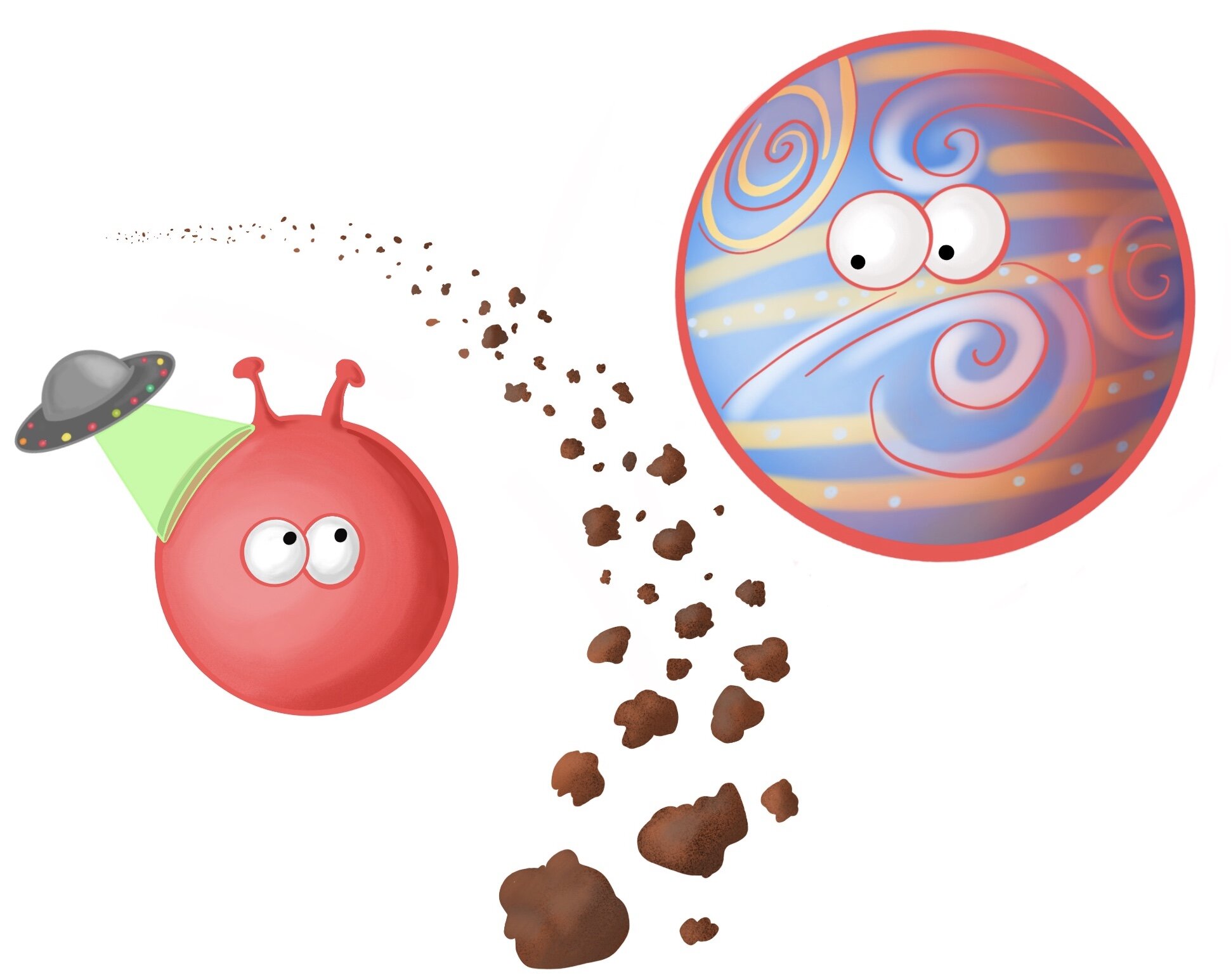
The Asteroid Belt is a band of dust, asteroids, and meteoroids that is found between Mars & Jupiter.
Asteroids and meteoroids are made up of rock, metal and dust, and they are mainly found in the Asteroid Belt between Jupiter and Mars. Asteroids can be as big as 1,000 kilometers across to as small a 1 meter across. These metallic space rocks orbit our sun, but they are not big enough to be a planet, or round like a planet.
Meteoroids are the same as asteroids, just smaller. They are larger than a grain of dust and smaller than an asteroid. Most could fit in your hand.
Meteors are better known as shooting stars. Meteors are meteoroids that burn up as they enter our atmosphere, leaving a beautiful flash of light in the sky. Even though they make a bright flash of light, they are usually small enough to fit in your hand.

Meteorites are meteoroids or asteroids that make it past our atmosphere and actually hit the earth. Even though most are very small they can cause a lot of damage because they are so fast. Meteoroids (and especially asteroids) rarely make it past our protective atmosphere, so meteorites are rare.
Meteor showers occur when the earth passes through a trail of dust and rocks left behind by a comet or asteroid. These objects burn up in the earth’s atmosphere, creating a meteor shower. Meteor showers are named after the constellations that they appear around in the night sky. Some of the most well known meteor showers are the Perseids and Orionids, named after the constellations Perseus and Orion.
If you can stay up late enough and endure the weather, you can see a meteor shower! It’s best to see a meteor shower after midnight and far from city lights. Use the helpful link below to find the best times for meteor showers where you live!
Astronomy: Parts of the Sun FREE PDF
Let’s learn about the earth’s closest star without getting a sunburn! This lesson includes a poster, lesson with memory helps, and a matching quiz.

The sun is a star! Stars are incredibly hot, enormous balls of plasma. The Sun is an ordinary star, but it is also a huge part of making life on earth possible! The sun gives us heat, energy, and light. The earth is exactly the right distance from earth for life to exist. If we were closer, we would be too hot— further away, we would freeze, and life could not exist.
Fill out the form below to download your FREE Sun Lesson PDF.
This PDF includes a poster, lesson with memory helps, and a matching quiz.
Inside the Sun: Core, Radiative Zone, and Convective Zone

The core is in the center of the sun. The sun is a giant heat machine powered by the core. If the sun was a mechanical toy, the core would be like the toy’s battery; except that it would also be 27 million degrees!
The core makes the sun’s energy through a process called nuclear fusion. Fusion is when atoms come so close to one another that they squish (or fuse) together. Atoms are very, very tiny, but they are powerful little things, and they won’t normally ever change their insides. Yet because the sun is so big, it is able to put enough pressure on these atoms that they squish together and become something entirely new! Fusion is sort of like smashing two apples together and the two of them become an orange! The sun isn’t made of apples, though. The sun is mostly made of hydrogen. When hydrogen atoms fuse together, they become helium. Fusion creates incredible energy, and this energy is what fuels the heat of the sun.


Radiative Zone
The next layer is the radiative zone. In the radiative zone energy from the core “rays” outward by radiation. Do you hear how radiation and radiative sound alike? These rays of light are called gamma rays and x-rays, and they are incredibly powerful. Storytellers often say that gamma rays are what changed ordinary people into superheroes! X-rays are powerful enough to see through your skin so we can take pictures of your bones. These powerful rays of light carry the energy of the sun to the next inside layer of the sun, the convective zone.

Convective Zone
The convective zone is where energy boils to the surface of the sun. Convection is when heat rises and cold drops. Think of how a pot of water boils on your stove. First the bottom of the pot gets hot. Then the water on the bottom forms little bubbles. Pretty soon, the water starts bubbling to the surface. As the bubbles rise to the surface of the water, the water that was at the top gets pushed to the bottom so it can heat up too. This boiling action of heat rising and dropping happens in the convective zone where the sun’s plasma boils heat up to the surface of the sun.
Outer Sun: Photosphere, Chromosphere, Corona, Sun Spots, and Solar Flares
The surface of the sun is called the photosphere. The photosphere is 300 miles thick and 10,000 degrees fahrenheit. This is where all the heat from the inside of the sun shines out of the sun as light! This is like the face of the sun. Smile for your photo, sun!
The sun’s surface is very bright, but sometimes the sun will get sun spots. Sun spots are darker, cooler spots on the sun. I think of sun spots like sun freckles, except they form and then go away. These spots form where the sun’s magnetic field is very strong. These cooler spots are a measly 6,500 degrees fahrenheit (which is still incredibly hot!).
There are two layers of light that shine brightly above the photosphere. These layers are the atmosphere of the sun. The earth’s atmosphere is made of the air around us. The sun’s atmosphere is made of gas that burns incredibly hot and keeps us toasty warm on earth.
The chromosphere is the first layer of the sun’s atmosphere. The chromosphere is a reddish layer of gas above the photosphere, and it can be seen during a solar eclipse. The chromosphere has spicules, which are spikes of gas growing up from the surface. Usually when kids draw the sun they also draw the sun’s atmosphere! They draw a circle with lines poking out from the sun, just like spicules! Kids are pretty smart.
The outermost layer of light is the corona. The corona looks like white streamers around the sun, and it can be seen during a total eclipse. Corona means “crown” in Latin, and it is the outermost layer of the sun’s atmosphere. The corona can get as hot as 3.5 million degrees fahrenheit, which is hotter than the surface of the sun!

Solar Flare
Sometimes the sun can reach beyond its atmosphere with an exploding solar flare! A solar flare is a giant plume of gas that stretches outside the sun’s magnetic field. These release a lot of radiation into space, and can even interfere with our radio communication on earth!
The sun is incredibly hot, amazingly bright, and overwhelmingly big. It is gives us heat and light, and without it we would freeze in the dark. We can be thankful for the beautiful bright sun that makes life possible.

Browse by category:
- Book Reviews 1
-
Buddy Blog
7
- Apr 4, 2019 Buddy Blog Epidsode 5: Counting!
- Nov 22, 2018 Buddy Blog, Episode 4: Happy Thanksgiving!
- Nov 13, 2018 Buddy Blog Episode 3: Fall Leaves
- Oct 30, 2018 Here’s your guide to Pumpkin Everything— Recipes, Crafts, and Carving
- Oct 30, 2018 Buddy Blog, Episode 1: Exercise
- Jul 18, 2018 Fish Fashion 2018
- Jul 13, 2018 Orange You Tired?
-
Cooking with Kids
3
- Jun 3, 2019 Guiltless Peanut Butter Cookies
- Oct 26, 2018 Love Pumpkin Spice? Try this New Fall Favorite
- Aug 9, 2018 Goodness Granola
-
Earth & Space
2
- Nov 9, 2019 Astronomy: Comets, Oids, and Shooting Stars!
- Oct 9, 2019 Astronomy: Parts of the Sun FREE PDF
-
For Parents
15
- Aug 28, 2025 How a Little Engine Could, and You Can Too
- Jun 4, 2021 What Kids Learn From Reading At Every Age
- Apr 27, 2021 7 Powerful Picture Books to Make Your Child Feel Loved
- Feb 24, 2021 Words of Healing
- Oct 20, 2020 Words: Sticks and Stones
- Oct 20, 2020 You are Wonderful! Marzette- A Parable of Redemption
- May 4, 2020 "My house is a disaster!" Cleaning hacks so you can embrace the fun
- Apr 7, 2020 Help, My Kid Is Bored! How to Stop Whining and Cure Boredom Fast
- Nov 9, 2019 Homeschool Styles 101: Your Quick Easy Guide to Find What Fits Your Family
- Jun 3, 2019 5 Quick Ways to Invent Stories Your Kids Will Love
- May 27, 2019 Today is for Eternity
- Nov 10, 2018 Know nothing except... a lesson in teaching my kids
- Oct 30, 2018 Why Stranger Danger Doesn’t Work (And What To Do Instead)
- Jun 14, 2018 "Did you have fun?" Asking better questions
- Jun 12, 2018 Another day at the superstore
-
Life Science
8
- Apr 1, 2025 Botany Basics: Parts of a Flower
- Jun 5, 2021 Flightless birds? Swimming Mammals? How awkward vertebrates fit
- Apr 28, 2021 Biology: Animal and Plant Cells
- Nov 9, 2018 Botany Basics: Plant Systems
- Oct 16, 2018 Biology Basics: How Animals Reproduce
- Oct 8, 2018 Vertebrates- Animals with Backbones
- Sep 25, 2018 Biology Basics: Invertebrates
- Sep 7, 2018 Biology Basics: Kingdoms
-
Physical Science
4
- Jul 22, 2022 Astrophysics for Kids! 25 Easy Experiments to Do at Home
- Feb 24, 2021 Chemistry: The Atomic World
- Apr 8, 2020 Thermodynamics ...for Kids!
- Jan 24, 2020 Newtonʻs 3 Laws of Motion
-
Poetry
2
- Oct 20, 2018 Be Someone's Rainbow
- Jul 18, 2018 Bugs
- Science 3
-
Teaching Aids
3
- Nov 8, 2025 Explore the Nervous System: Cool Facts & Games for Kids!
- Jul 8, 2020 Phonics Fun for FREE
- Oct 21, 2018 How to draw a dog named Buddy