
Biology Basics: Invertebrates
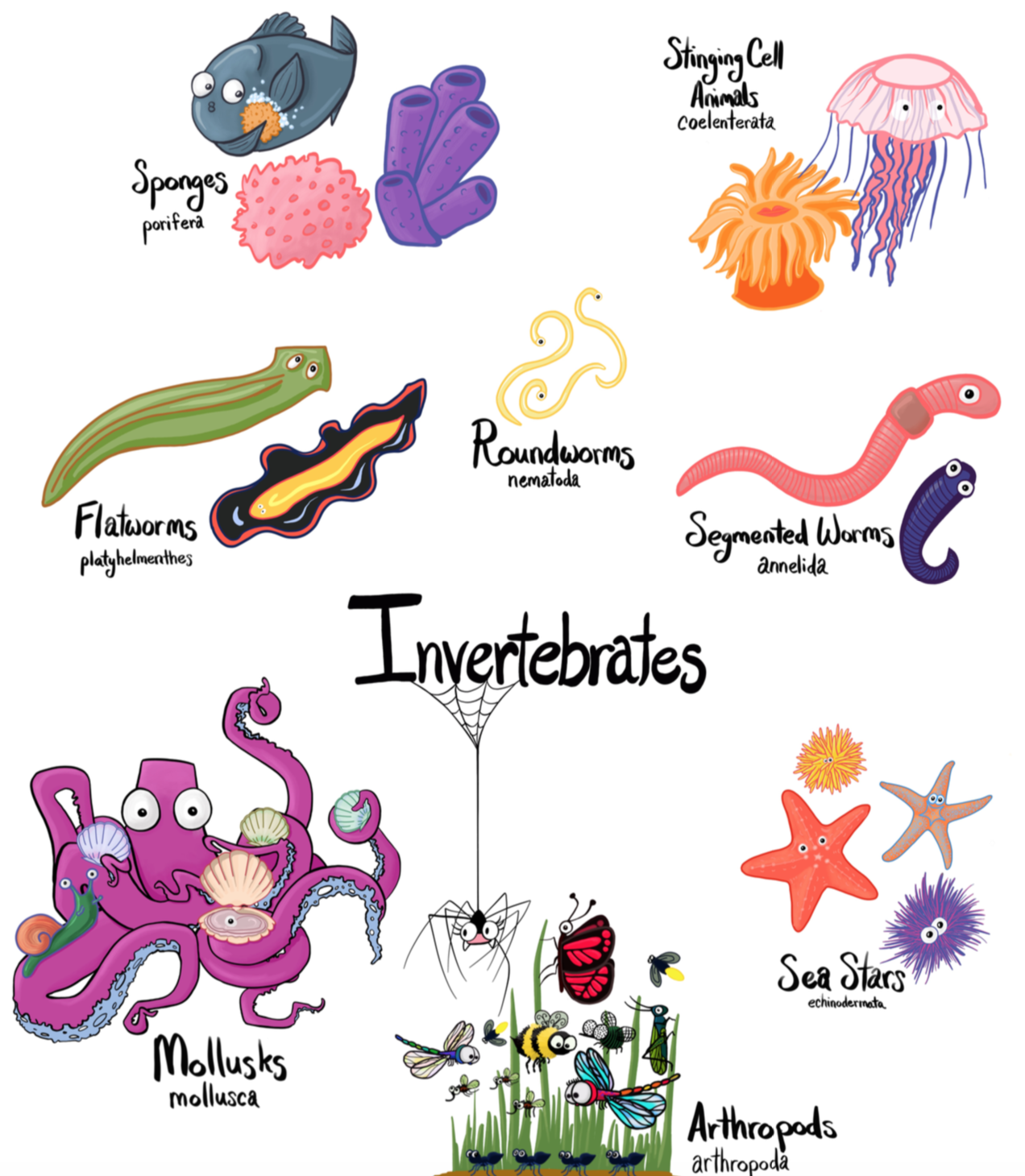
Invertebrates are definitely some of the weirdest, creepiest, slimiest and most interesting creatures on earth. Worms, bugs, octopus and jellyfish all fall into the category of inveterate animals. When looking at the classification of the animal kingdom, there are 9 major phylum, and 8 of these are invertebrates! These 8 phylum, or body-type classifications are sponges, stinging cell animals, three groups of worms (flat, round, segmented), mollusks, echinoderms (also known as sea stars), and arthropods.
One of the best parts about studying invertebrates is the ease of finding them in your own backyard. Many of the invertebrates are easy to find if you just dig in your garden, or even, heaven forbid, look in your basement! If your kids have the courage, they can handle the creepy creatures and study them first hand- literally!
I’ve attached a handy dandy printable with a poster, study guide, and a quiz. Hope you enjoy this invertebrate study tool!

Check out the full Life Science Workbook!
Jolie Canoli Life Science workbook is packed with playful illustrations, easy to understand science lessons, playful quizzes, and educational activities. Perfect for elementary students studying Classification of Living Things, Biology and Botany.
Biology Basics: Kingdoms
As a homeschool mom, I have delved into the world of science with some particular aims in mind, specifically feeding curiosity, developing admiration in the beauty and design of creation, and finding the fun! Sometimes learning terms mean very little to young ones, and I hope to inspire both memory and understanding by creating visuals that are sticky for kids brains. By sticky I mean, let's make it stick!
You are welcome to download our FREE handy-dandy PDF with a little poster of playful visuals, facts that explain the terms, and a mini quiz to help with little minds recall what they learn.
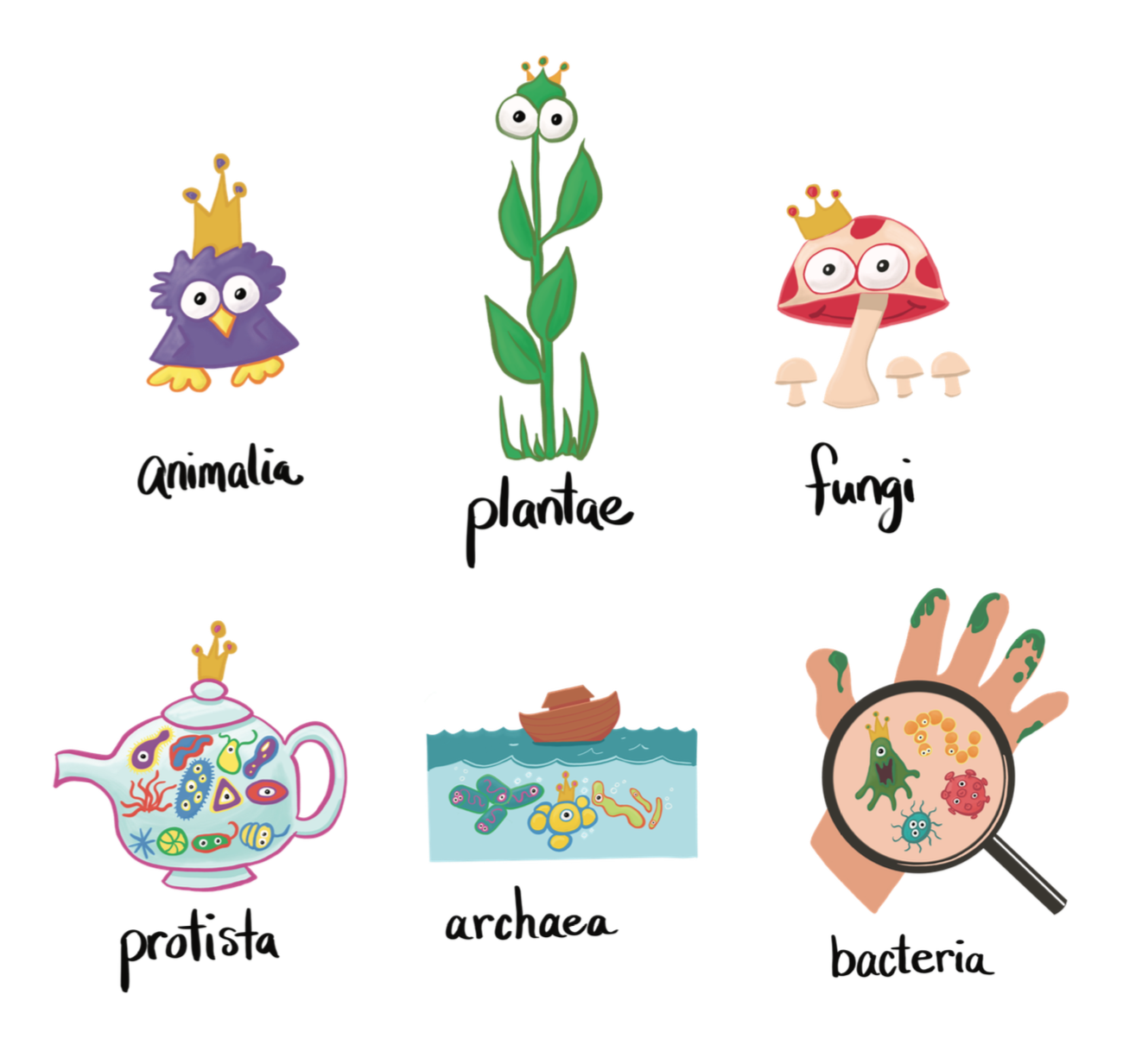
Here is some information you might want to know about these 6 Kingdoms of living things!
Animalia is the kingdom of animals. Animals include invertebrates like insects, and vertebrates like mammals and birds. Six important aspects of animals are:
1. Animals are multicellular, which means they have many cells.
2. Animal cells do not have cell walls.
3. Animals consume food.
4. Almost every animal reproduce sexually.
5. Animals are able to move at some time during their life.
6. Animals have nervous systems and respond to the things they sense around them.
Plantae is the kingdom of plants. Important characteristics of plants are:
1. Plants are multicellular.
2. Plant cells have cells walls and unique organelles.
3. Plants produce food through a process called photosynthesis.
4. Plants usually can’t move because they are rooted to one place.
5. Plants reproduce sexually or asexually. Some reproduce with seeds through pollination, others through spores, or even asexually as with rhizomes or tubers.
Fungi are multicellular decomposers like mold, moss, and mushrooms, but a few of them can be single-celled, like yeast. Fungi digest their food outside themselves and then absorb it. This process decomposes dead things and turns them into useful things like soil. They do not produce food through photosynthesis like plants do, so they don’t need light!
Protista has the sound "tea" in it and has a large variety of organisms that all fit into one pot, or kingdom, that is. Most are single-celled organisms, but some have many cells, like algae. Protista have a nucleus, organelles, and sometimes chloroplasts. Some can move with little hair-like things called cilia, or tail-like flagella. They get their food either through photosynthesis like plants do, ingestion like animals do, or both!
Archaea (has the sound ark in the beginning!) are single-celled organisms, meaning they are so tiny they cannot be seen without a microscope. Archaea do not have a nucleus and can live through all sorts of extreme conditions and temperatures.
Bacteria are single-celled organisms that have a cell wall, but they do not have organelles or an organized nucleus. Some are helpful, such as producing vitamins or food. Others are harmful and cause disease, so wash your hands before you eat just in case you picked up some unhelpful bacteria!
Enjoy your free resource from Jolie Canoli, and stop by again- there's more to come!
Browse by category:
- Book Reviews 1
-
Buddy Blog
7
- Apr 4, 2019 Buddy Blog Epidsode 5: Counting!
- Nov 22, 2018 Buddy Blog, Episode 4: Happy Thanksgiving!
- Nov 13, 2018 Buddy Blog Episode 3: Fall Leaves
- Oct 30, 2018 Here’s your guide to Pumpkin Everything— Recipes, Crafts, and Carving
- Oct 30, 2018 Buddy Blog, Episode 1: Exercise
- Jul 18, 2018 Fish Fashion 2018
- Jul 13, 2018 Orange You Tired?
-
Cooking with Kids
3
- Jun 3, 2019 Guiltless Peanut Butter Cookies
- Oct 26, 2018 Love Pumpkin Spice? Try this New Fall Favorite
- Aug 9, 2018 Goodness Granola
-
Earth & Space
2
- Nov 9, 2019 Astronomy: Comets, Oids, and Shooting Stars!
- Oct 9, 2019 Astronomy: Parts of the Sun FREE PDF
-
For Parents
15
- Aug 28, 2025 How a Little Engine Could, and You Can Too
- Jun 4, 2021 What Kids Learn From Reading At Every Age
- Apr 27, 2021 7 Powerful Picture Books to Make Your Child Feel Loved
- Feb 24, 2021 Words of Healing
- Oct 20, 2020 Words: Sticks and Stones
- Oct 20, 2020 You are Wonderful! Marzette- A Parable of Redemption
- May 4, 2020 "My house is a disaster!" Cleaning hacks so you can embrace the fun
- Apr 7, 2020 Help, My Kid Is Bored! How to Stop Whining and Cure Boredom Fast
- Nov 9, 2019 Homeschool Styles 101: Your Quick Easy Guide to Find What Fits Your Family
- Jun 3, 2019 5 Quick Ways to Invent Stories Your Kids Will Love
- May 27, 2019 Today is for Eternity
- Nov 10, 2018 Know nothing except... a lesson in teaching my kids
- Oct 30, 2018 Why Stranger Danger Doesn’t Work (And What To Do Instead)
- Jun 14, 2018 "Did you have fun?" Asking better questions
- Jun 12, 2018 Another day at the superstore
-
Life Science
8
- Apr 1, 2025 Botany Basics: Parts of a Flower
- Jun 5, 2021 Flightless birds? Swimming Mammals? How awkward vertebrates fit
- Apr 28, 2021 Biology: Animal and Plant Cells
- Nov 9, 2018 Botany Basics: Plant Systems
- Oct 16, 2018 Biology Basics: How Animals Reproduce
- Oct 8, 2018 Vertebrates- Animals with Backbones
- Sep 25, 2018 Biology Basics: Invertebrates
- Sep 7, 2018 Biology Basics: Kingdoms
-
Physical Science
4
- Jul 22, 2022 Astrophysics for Kids! 25 Easy Experiments to Do at Home
- Feb 24, 2021 Chemistry: The Atomic World
- Apr 8, 2020 Thermodynamics ...for Kids!
- Jan 24, 2020 Newtonʻs 3 Laws of Motion
-
Poetry
2
- Oct 20, 2018 Be Someone's Rainbow
- Jul 18, 2018 Bugs
- Science 3
-
Teaching Aids
3
- Nov 8, 2025 Explore the Nervous System: Cool Facts & Games for Kids!
- Jul 8, 2020 Phonics Fun for FREE
- Oct 21, 2018 How to draw a dog named Buddy