
Chemistry: The Atomic World
Meet those ever grumpy negative electrons, positively upbeat protons, leaping leptons, quacking quarks and more in this fun chemistry lesson that includes flashcards and build an atom printable.

Learn about atoms—the building blocks of the universe— with fun illustrations and examples that are easy for kids to understand and remember.
Get the full 12-page Chemistry PDF for $2.99 here
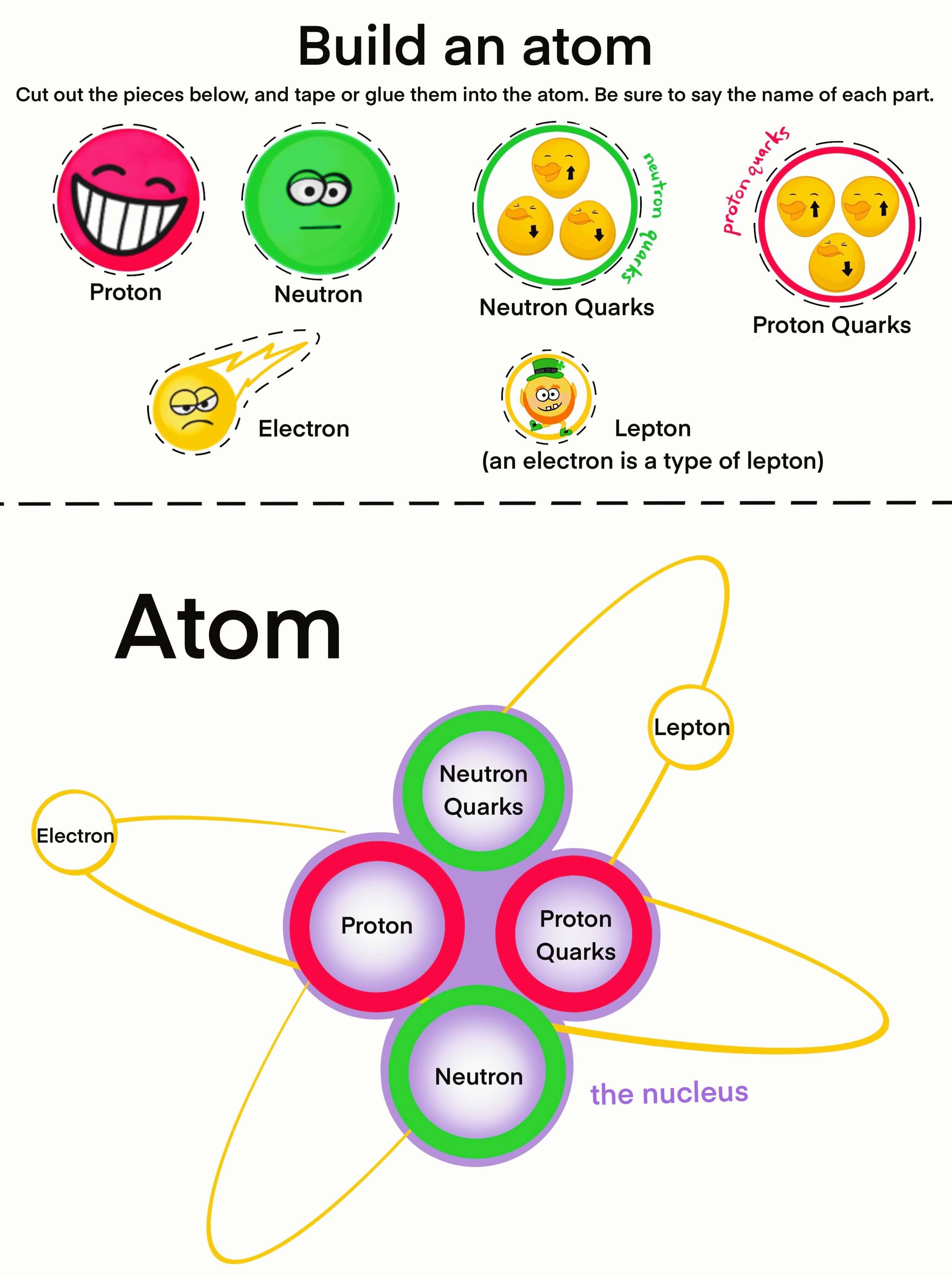
This colorful 12-page PDF include lessons on the parts of an atom (with a “build an atom” activity), what are quarks and leptons, what are molecules, and meeting the first 12 elements of the periodic table with corresponding flashcards!
or
Download the FREE 3-page Atom PDF by filling in the form below.
Atoms are the building blocks of everything we see! Atoms are so tiny that until a few years ago no one had actually ever seen them, even with a microscope! Atoms are so tiny that light cannot touch them, so they had to invent a different kind of microscope using parts of an atom to even see them! Your hair is 500,000 times wider than an atom. That is really small!
A Greek scientist came up with the name for the atom, the word “Atomos.” This word means “that which cannot be split.”
Imagine a tower of legos. The more you took apart the legos, the smaller the tower would become, until you only had one lego left. If you broke apart the lego, it would no longer be a lego, but only plastic bits. Atoms are like legos, the building blocks of matter. Like legos, atoms can combine with other atoms to form new things, but all ordinary matter is made of atoms. These atoms combine to form everything we see and touch— even the air!
Parts of an Atom
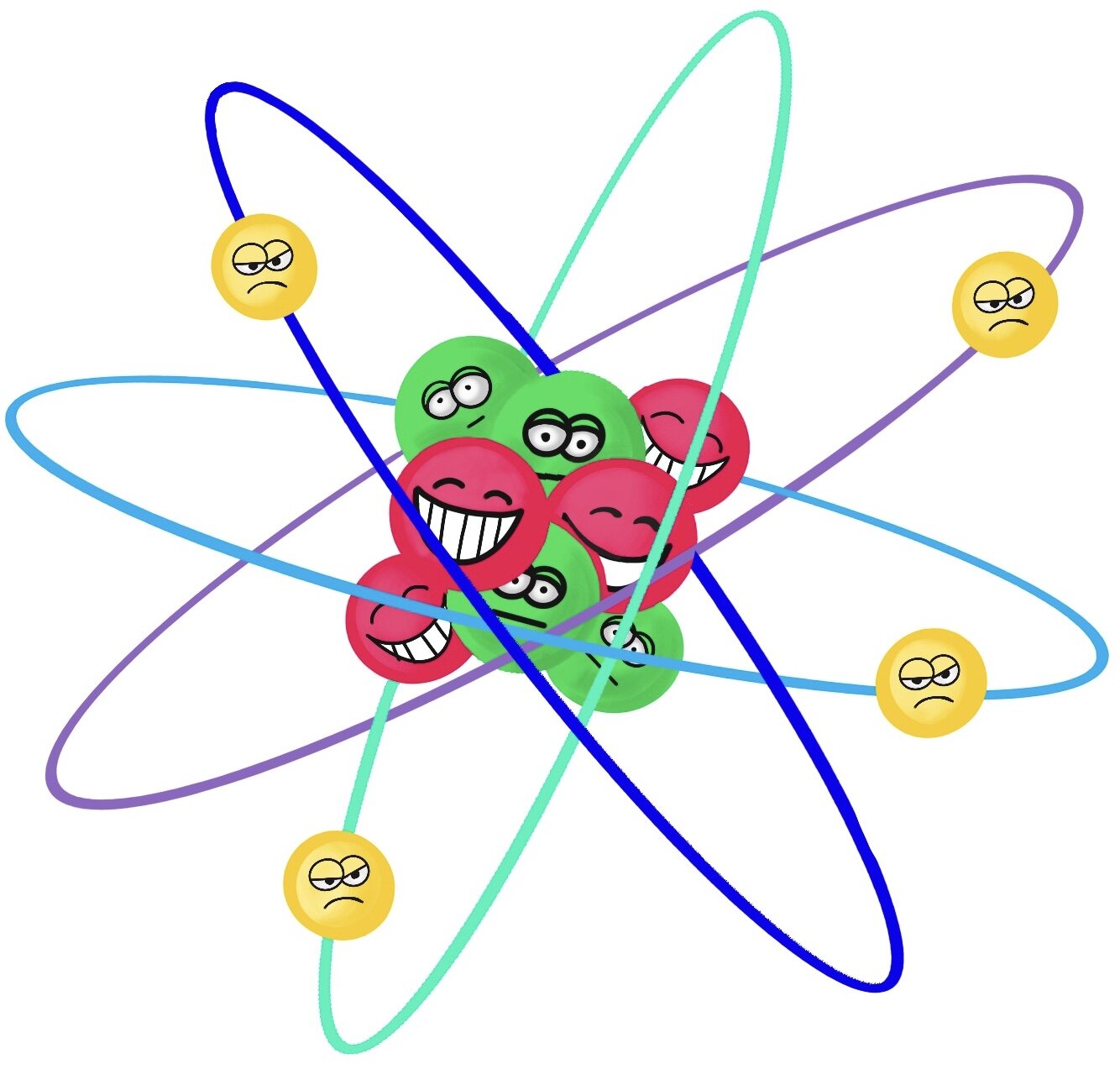
The basic parts of atoms are protons, neutrons, and electrons. The protons and neutrons form a tight ball in the center called a nucleus. The electrons zoom around the outside of the nucleus.

The nucleus is made of protons and neutrons. Protons are positive- see how they smile? They give atomʻs their identity. If the atom has 2 protons, it is helium. If the atom has 47 protons, it is silver. The atom can have a different number of neutrons or electrons, but the number of protons it has tells us what element the atom is.

Neutrons help protons stick together in the nucleus.
Neutrons act like a glue to keep the protons together. Opposites attract, and like charges repel, so if the positively charged protons were all pushed together, they would repel each other. The neutrons are neutral, meaning they have no charge, so they keep all the positive protons from repelling each other.

Electrons have a negative charge— see how negative they are with their grumpy faces? Electrons orbit the nucleus super fast. They are so fast that the electrons forms what seems like a shield around the outside of the nucleus.
Electrons spin and rotate around the outside of the nucleus— kind of like planets orbiting the sun! As the electrons circle the nucleus, they travel at certain energy levels but can "jump" between different energy levels if they gain or lose energy.
Letʻs remember these names with some gestures:
Protons (smile and thumbs up!)
Neutrons (arms at your sides)
Nucleus (clasp your hands together),
Electrons (point your fingers and spin them in a fast circle in front of you.)
Zap-Pow! Try it!

Rub your feet on carpet.
You can make charged atoms. As you rub your feet on carpet, you pick up extra electrons from the carpet. This causes static electricity. If you reach for a friend after rubbing your feet on the carpet, you might feel a little zap. This zap is the electrons traveling from you to another place.
Rub a balloon on your head. When you rub a balloon on your head, you rub electrons off your head onto the balloon. The atoms missing electrons are positive, and the extra electrons are negative. These atoms have opposite charges, so they are attracted to each other. This will make your hair attracted to the balloon!

Click here to get the 12-page Chemistry PDF! Includes lessons on atoms, quarks, leptons, molecules, flashcards of the first 12 elements of the periodic table.
Browse by category:
- Book Reviews 1
-
Buddy Blog
7
- Apr 4, 2019 Buddy Blog Epidsode 5: Counting!
- Nov 22, 2018 Buddy Blog, Episode 4: Happy Thanksgiving!
- Nov 13, 2018 Buddy Blog Episode 3: Fall Leaves
- Oct 30, 2018 Here’s your guide to Pumpkin Everything— Recipes, Crafts, and Carving
- Oct 30, 2018 Buddy Blog, Episode 1: Exercise
- Jul 18, 2018 Fish Fashion 2018
- Jul 13, 2018 Orange You Tired?
-
Cooking with Kids
3
- Jun 3, 2019 Guiltless Peanut Butter Cookies
- Oct 26, 2018 Love Pumpkin Spice? Try this New Fall Favorite
- Aug 9, 2018 Goodness Granola
-
Earth & Space
2
- Nov 9, 2019 Astronomy: Comets, Oids, and Shooting Stars!
- Oct 9, 2019 Astronomy: Parts of the Sun FREE PDF
-
For Parents
15
- Aug 28, 2025 How a Little Engine Could, and You Can Too
- Jun 4, 2021 What Kids Learn From Reading At Every Age
- Apr 27, 2021 7 Powerful Picture Books to Make Your Child Feel Loved
- Feb 24, 2021 Words of Healing
- Oct 20, 2020 Words: Sticks and Stones
- Oct 20, 2020 You are Wonderful! Marzette- A Parable of Redemption
- May 4, 2020 "My house is a disaster!" Cleaning hacks so you can embrace the fun
- Apr 7, 2020 Help, My Kid Is Bored! How to Stop Whining and Cure Boredom Fast
- Nov 9, 2019 Homeschool Styles 101: Your Quick Easy Guide to Find What Fits Your Family
- Jun 3, 2019 5 Quick Ways to Invent Stories Your Kids Will Love
- May 27, 2019 Today is for Eternity
- Nov 10, 2018 Know nothing except... a lesson in teaching my kids
- Oct 30, 2018 Why Stranger Danger Doesn’t Work (And What To Do Instead)
- Jun 14, 2018 "Did you have fun?" Asking better questions
- Jun 12, 2018 Another day at the superstore
-
Life Science
8
- Apr 1, 2025 Botany Basics: Parts of a Flower
- Jun 5, 2021 Flightless birds? Swimming Mammals? How awkward vertebrates fit
- Apr 28, 2021 Biology: Animal and Plant Cells
- Nov 9, 2018 Botany Basics: Plant Systems
- Oct 16, 2018 Biology Basics: How Animals Reproduce
- Oct 8, 2018 Vertebrates- Animals with Backbones
- Sep 25, 2018 Biology Basics: Invertebrates
- Sep 7, 2018 Biology Basics: Kingdoms
-
Physical Science
4
- Jul 22, 2022 Astrophysics for Kids! 25 Easy Experiments to Do at Home
- Feb 24, 2021 Chemistry: The Atomic World
- Apr 8, 2020 Thermodynamics ...for Kids!
- Jan 24, 2020 Newtonʻs 3 Laws of Motion
-
Poetry
2
- Oct 20, 2018 Be Someone's Rainbow
- Jul 18, 2018 Bugs
- Science 3
-
Teaching Aids
3
- Nov 8, 2025 Explore the Nervous System: Cool Facts & Games for Kids!
- Jul 8, 2020 Phonics Fun for FREE
- Oct 21, 2018 How to draw a dog named Buddy